
The Environment Agency has published its annual report on managing flood and coastal erosion risk in England for the period April 2014 to March 2015, flagging up technology and innovation as key to asset condition and maintenance.
Introducing the report, Environment Agency Chief Executive Dr Paul Leinster said the year 2014 to 2015 had “proved to be one of challenges and achievements” in flood and coastal erosion risk management in England.
By April 2014, one of the biggest ever flood and coastal risk management recovery programmes in England was underway to repair assets damaged by the tidal surge and storms of the previous winter. Risk management authorities across the country identified 890 projects for urgent attention.
At the same time, the Environment Agency, local councils and internal drainage boards completed the largest programme of capital works in any one year. A total of 111 new flood and coastal risk management schemes were completed during 2014 to 2015, reducing flood risk for 31,700 households and reducing coastal erosion risk for a further 1,000.
This brings the total number of households benefiting from investment to reduce risk between April 2011 and March 2015 to 177,300, exceeding the 165,000 target for the period by more than 12,000.
Asset condition and maintenance – technology and innovation are key
The report also highlights the significant number of flood infrastructure assets in place in England. The Environment Agency maintains 7,000 km of raised walls and embankments on main rivers, 1,000 km of coastal schemes, 22,600 structures and 39,000 km of channels. Local authorities, internal drainage boards and private riparian owners are responsible for maintaining a further 1,700km of raised walls and embankments and 9,600 structures.
The report says technology and innovation are key to effective and efficient flood and coastal risk management. The Environment Agency's Creating Asset Management Capacity project is designed to improve effectiveness and efficiency in managing infrastructure assets. During 2015, the project will deliver new technology to support improved maintenance work management, programming and funding allocation. The Environment Agency will also introduce mobile devices for asset inspections and field work. The report says the initiatives are contributing to placing the Environment Agency at the forefront of efficient asset management.
Sustainable drainage part of work with other risk management authorities
The report also covers the Agency’s work with other flood risk management authorities, including the Internal Drainage Boards, Lead Local Flood Authorities, the water companies and Highways England , a new company set up in 2015 now wholly owned by the government (formerly the Highways Agency).
The Weston-Super-Mare integrated urban drainage scheme to reduce flood risk and improve bathing water quality, which involved joint working between North Somerset Council, the Environment Agency and Wessex Water, is among a number of examples included in the report.
Wessex Water contributed to North Somerset Council for the design, construction, use of the land and a commuted sum for future maintenance of the above ground storage area.The water company also provided 25,000cubic metres of storage by using both traditional and sustainable techniques.
Highways England’s delivery plan for 2015 to 2020, commits the company to invest £78 million over the next five years to address flooding and pollution from highway runoff. It also has a longer term commitment to complete a wide-ranging retrofit of the network by 2040 to raise environmental standards by providing ring-fenced funding for environmental improvements.
The report says these 2 initiatives will help to improve the resilience of the road network; reduce the risk of flooding and pollution to communities adjacent to the network, and improve water quality by using sustainable drainage systems.
Funding - £2.6bn+ to be invested between 2015-21
During 2014 to 2015, the Agency published a 6 year capital programme of works which will see an investment of £2.3 billion of government grant-in-aid between 2015 and 2021, supplemented by at least £345 million of partnership funding.
Other sources of investment in 2014 to 2015 included £32 million in local levy provided by local councils to the 12 Regional Flood and Coastal Committees. Committees invested £24 million this year and the remainder carries forward for future identified investment, now totalling £45 million.
The report says capital projects undertaken which were completed during 2014 to 2015, achieved whole-life benefits of £1.78 billion against whole-life costs of £161 million. Analysing all projects completed between April 2011 and March 2015 gives total whole-life benefits of £16.7 billion against whole-life costs of £1.41 billion. This investment provided a net present value of £13.7 billion and £12 of economic benefit for every £1 investment. Taking into account other capital expenditure, the overall programme benefit-to-cost ratio achieved since April 2011 is 9.8 to 1.
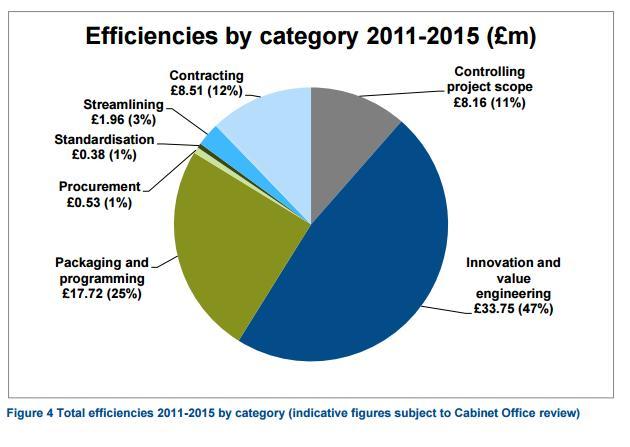 £27m+ efficiency savings in 2014-15
The report also flags up specific activities where the Environment Agency actively seeks to make efficiency savings in the following categories:
- innovation and value engineering, such as using innovative solutions, materials or construction methods in schemes to meet project objectives for less cost
- packaging similar projects together, including by geography, project type or timeframe, helping suppliers offer better value and maximising project management benefits
- using different contracting methods to spread risk and gain greater value
- controlling the scope of a project by challenging the agreement of original project scope and outcomes, and to any changes that are proposed during the project
By using these and other approaches, during 2014 to 2015 the Environment Agency saved £27.22 million (against a target of £26.4 million), bringing savings since April 2011 to £71.18 million, against a target of £65.96 million.
Millions of properties remainat risk from flooding
Significant numbers of properties are still estimated to be at risk of flooding in England, with the potential impacts of climate change an increasing source of concern. The Environment Agency estimates the number of residential and commercial properties in areas at risk of flooding to be:
- 2.4 million properties in areas at risk of flooding from rivers and the sea
- 3 million properties in areas at risk of flooding from surface water
- approximately 600,000 properties in areas at risk of flooding from surface water, river and / or the sea
- between 122,000 and 290,000 properties in areas at risk of flooding from groundwater (not including properties also in areas at risk of flooding from rivers and the sea, but may include properties also in areas at risk of flooding from surface water)
The Environment Agency also estimates that over 700 properties could be lost to coastal erosion by around 2030, and over 2000 could be lost by around 2060. These estimates take into account the interventions proposed in shoreline management plans (SMPs). Without the interventions, these figures could increase to about 5,000 properties by 2030 and about 28,000 by 2060.
Defra review to assess where Pitt recommendations are being realised
The Department for Environment, Food and Rural Affairs (Defra) is currently undertaking a post- implementation review of parts of the Flood and Water Management Act 2010 to assess whether Sir Michael Pitt’s ambitions for better local flood risk management are being realised. The review will focus on the lead local flood authority role (LLFA) and partnership working under the Act.
To provide the evidence for the review, Defra has commissioned an evaluation by external consultants which considered the arrangements for managing local flood risk, including how lead local flood authorities are undertaking their responsibilities to manage local flood risk. The evaluation is due to conclude in this month, with a report published in autumn 2015. The Defra-led review of elements of the Act will follow on from this.
Agency to report on economic impacts of flooding in 2013 and 2014
Following significant flooding in 2012 to 2013, the Environment Agency developed a flood cost calculator to estimate the economic impacts of flooding. The calculator was used to provide preliminary information on the economic costs of the winter flooding in 2013 to 2014. The Environment Agency has now carried out a more detailed analysis of the costs of the 2013 to 2014 winter flooding, which will be published in summer 2015. Work to improve the flood cost calculator will also enable more robust preliminary national scale assessments of the costs of significant flood events in future.
Looking further ahead, the Environment Agency will be publishing the final first cycle flood risk management plans and updated river basin management plans in December 2015. All European member states are required to report to the European Commission on production of these plans by March 2016.
In February 2016 the Environment Agency will also convene a major 3 day conference, ‘Flood and Coast 2016’, as part of its strategic overview role.
Click here to download the report in full.