
The Environment Agency has submitted plans to create a large ‘aquagreen’ to reduce flood risk to homes and businesses near Bransholme in east Hull for planning approval as part of the £28.5 million Holderness Drain Flood Alleviation Scheme.
Flood water in Holderness Drain, November 2019.
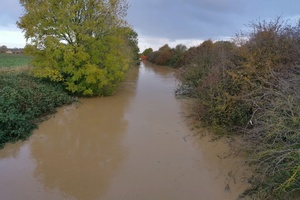
Image credit: Hull City Council
A public consultation was launched in September 2020 on the proposals for a versatile green space, south of the old Bransholme Dairy Farm, that will store excess water during a flood and then slowly release it back into the drainage system after the peak of the flood has passed.
Findings from the public consultation were analysed and resulted in several changes to the scheme. Following feedback from the community and partners, the plans have been revised and submitted to Hull City Council and East Riding of Yorkshire Council for approval.
Homes in North Carr and Sutton are currently at risk of flooding from water in the Holderness and Sutton Cross drains after heavy rain. The Holderness Drain is a man-made river channel. When it becomes full, water flows into Sutton Cross Drain, overwhelming the local drainage system and increasing the risk of flooding for homes in the area. The area almost flooded in November 2019 when other parts of Hull were hit.
If approved, the ‘aquagreen’ will be the second phase of the £28.5 million Holderness Drain Flood Alleviation Scheme, following construction of the new East Hull Pumping Station, which started earlier last year.
Andrew Barron, Environment Agency flood risk advisor for Hull, commented:
“We are now in a position to submit our final plans for this scheme, which will significantly reduce the likelihood of flooding for properties in the North Carr and Sutton areas of Hull by storing flood water in the aquagreen.”
Councillor Mike Thompson, portfolio holder for Neighbourhoods, Community and the Environment at Hull City Council, said the scheme not only offered a reduction in flood risk, but would also help the city adapt to the increasing challenges of climate change.
Councillor Chris Matthews, portfolio holder for strategic property and infrastructure at East Riding of Yorkshire Council, added:
The construction of the ‘aquagreen’ will involve digging an extra drain, east of Sutton Cross Drain, building a new embankment beside it and digging a long wide ditch at the southern end of the site to increase the capacity for temporarily storing water during a flood.
Once a flood is over, most of the water will drain away although the site is designed to remain wet in some areas. As part of the plans, several low spots will be raised on both sides of the Holderness Drain to reduce the risk of flood water spilling out onto the land next to the drain.
Proposals for the site also include:
improving access and creating a network of paths and bridleways
creating a range of different habitats for wildlife including woodland, hay meadow, scrubland, reed beds and small ponds
offering better protection for the Castle Hill monument and installing information boards about its history
The partnership scheme, led by the Environment Agency and supported by Hull City Council, East Riding of Yorkshire Council, Highways England and the Humber Local Enterprise Partnership’s Local Growth Fund Programme, will better protect around 1,000 properties and help to provide a long-term, more sustainable solution to the problem of flooding in this area.
Highways England is providing £5 million towards the Holderness Drain Flood Alleviation Scheme.
The Humber Local Enterprise Partnership secured £2.14 million towards the project through the Local Growth Fund as part of the Government’s commitment to the Northern Powerhouse.