
The House of Lords Environment and Climate Change Committee is warning that England’s water supply is under growing strain and that, without urgent action, the risk of drought in England threatens the very systems on which people and nature depend.
In its report ‘Surviving drought: reclaim the rain’ published today, the cross-party ECC Committee is calling for urgent action to improve drought planning and monitoring, invest in water storage infrastructure at all scales, reform abstraction licensing to increase flexibility, and engage in a whole of society approach to reducing water demand.
Baroness Sheehan, Chair of the Environment and Climate Change Committee commented:
“England is at risk of sleepwalking into serious water scarcity if the Government does not act now to safeguard the water system. Water scarcity is not only a problem for public water supply. If we get this wrong, our ecosystem could change beyond recognition a flora and fauna that depend on water are threatened.”
The report says the UK is not short of rain — but it must store, manage, and reuse it much better to help prevent both drought and flooding. However, it warns that the country’s water supply is under growing strain due to a combination of climate change, population growth, public water supply leakage and water intensive industries.
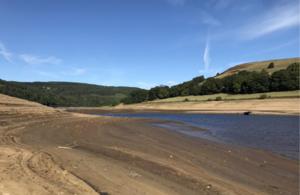
Photo: Drought - low water levels Derwent Valley Reservoir
England is currently on course for a public water supply deficit of 5 billion litres a day by 2055. The frequency and severity of drought is predicted to increase as a result of global warming, which affects rainfall patterns and temperature.
To strengthen England’s water security, the Committee is calling on the Government to:
- Conduct a full economic and environmental assessment for each of their future drought scenarios to enable the cost of drought mitigation to be balanced against the threat that drought poses to our economy and ecosystems.
- Invest in drought data collection and sharing so that all relevant stakeholders are armed with the information they need at the earliest possible opportunity, including creating a drought monitoring portal which can be used by national, regional and local drought responders to trigger early mitigation action before drought impacts manifest.
- Publish a prioritisation plan for an emergency drought situation by no later than autumn 2026. The plan should be clearly communicated to all sectors and stakeholders, including the public, to ensure that they can prepare accordingly.
- Foster a whole of society approach to drought management by ensuring a year-round engagement plan on water use is in place by December 2026.
- Reduce potable water demand by strengthening Part G of the Building Regulations 2010 to require new homes to achieve a maximum water usage of 105 litres per person per day, accelerating the uptake of grey water reuse in new builds, and working with regulators to provide incentives for households and businesses to implement water efficiency and water reuse measures.
- Make water companies statutory consultees on all major planning decisions, including housing developments, data centres, and energy infrastructure projects, to support water resource planning and ensure future water needs are accounted for.
- Increase water storage by ensuring large reservoirs are delivered and clarifying what support will be given to enable local water supply options, such as smaller reservoirs on farms, golf courses and other appropriate spaces.
- Strengthen roles and responsibilities, including expanding the remit of Internal Drainage Boards to include wider water resource management, clarifying how new Water Abstractor Groups will be established and empowering local abstractors to deliver local resource options, and giving Regional Water Resource Groups statutory authority and clearer guidelines.
- Modernise and streamline drought permitting and abstraction processes, including specifying the date by which it plans to move abstraction licensing into the Environmental Permitting Regime (EPR).
- Prioritise nature-based solutions (NbS) in both the urban and rural environment as a first line of defence to manage the increasing risk of both flooding and drought.

Baroness Sheehan, Chair of the ECC Committee said:
“Climate change is increasing the risk of drought through a combination of hotter summers and heavier winter rains making the capture and storage of rainwater increasingly important.
“The experience of the 2025 drought sent a warning signal to the water and drought management system. We have already had a dry start to this spring, so it is critical that action is taken now to prepare for serious drought conditions, particularly as we enter a reported El Niño year.
“We heard during our inquiry that if action is not taken now, public water demand could exceed supply by five billion litres every day (equivalent to 2000 Olympic swimming pools) by 2055. As a result, serious thought, planning and investment must go into managing the environmental and economic threats that drought poses to England.
“Our report provides the Government with practical recommendations which, if implemented, would accelerate England towards drought resilience.
“Water is the foundation of life itself. the Government must act now to secure England’s most vital resource for the future and work with the public to ensure the taps don’t run dry.”
The Committee received oral and written evidence from a wide-ranging number of witnesses during the inquiry, including water companies, Ofwat, Environment Agency, Defra, water resource experts, water consumer group representatives, agricultural and industrial sector representatives, farmers and community groups, environmental NGOs, local authorities, regulators and the Government.
Click here to download the report Surviving drought: reclaim the rain in full