
The World Economic Forum has published the 12th Edition of its Global Risks Report for 2017 – with environmental concerns more prominent than ever and water flagged up as a key risk.
For the past seven editions of the report, a cluster of interconnected environment-related risks – including extreme weather events, climate change and water crises – has consistently featured among the top-ranked global risks.
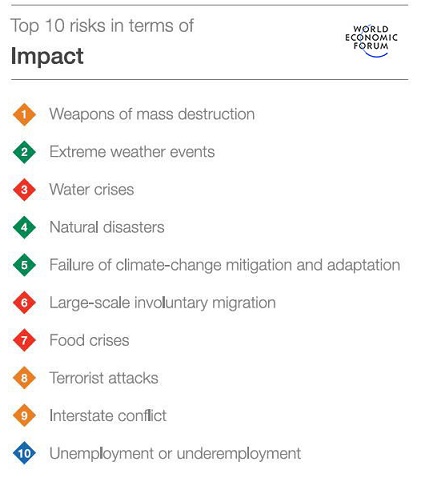 The report says that the environmental category in the Global Risks Perception Survey (GRPS) of the report this year stands out in the GRPS. This year all five risks in this category are assessed as being above average for both impact and likelihood. Every risk in the category lies in the higher-impact, higher-likelihood quadrant.
“Over the course of the past decade, a cluster of environment-related risks – notably extreme weather events and failure of climate change mitigation and adaptation as well as water crises – has emerged as a consistently central feature of the GRPS risk landscape, strongly interconnected with many other risks, such as conflict and migration.”, the report says.
Environmental risks are also closely interconnected with other risk categories. Four of the top ten risk interconnections in this year’s GRPS involve environmental risks, the most frequently cited of these being the pairing of “water crises” and “failure of climate change mitigation and adaptation”.
WEF says that this shows that ineffective management of the “global commons” – the oceans, atmosphere, and climate system – can have local as well as global consequences. For example, changing weather patterns or water crises can trigger or exacerbate geopolitical and societal risks such as domestic or regional conflict and involuntary migration, particularly in geopolitically fragile areas.
The report is also flagging up World Bank forecasts that water stress could cause extreme societal stress in regions such as the Middle East and the Sahel, where the economic impact of water scarcity could put at risk 6% of GDP by 2050. The Bank also forecasts that water availability in cities could decline by as much as two thirds by 2050, as a result of climate change and competition from energy generation and agriculture.
“The confluence of risks around water scarcity, climate change, extreme weather events and involuntary migration remains a potent cocktail and a “risk multiplier”, especially in the world economy’s more fragile environmental and political contexts”, the report says.
Commenting on physical infrastructure networks, WEF says water could also transition from centralized networks towards more distributed systems. New materials and sensor technologies allow treatment at the household or community level, creating opportunities to harvest rainwater and directly reuse waste water.
The report points out that for the time being, economies of scale still favour large, centralized plants in existing urban areas: they also allow utilities to monitor water quality centrally and address failures quickly. Relying on localized water storage would also create challenges in prolonged periods of drought.
However, it goes on to suggest that centralized networks are costly to create, and the balance of costs and benefits is beginning to tip in favour of distributed water systems if cities can be planned for these systems from the outset.
Click here to download the report in full.
Click here to watch the press conference launching the report on the Waterbriefing Watch channel.