
Rob Lawson, Water Resources Director at Artesia Consulting explores the issues around Ofwat’s recent report on the long-term potential for deep reductions in household demand in the context of current AMP7 business planning.
Rob Lawson: Ofwat published their report on the long-term potential for deep reductions in household water use in early May. This identified four future scenarios that illustrated how personal water use could be reduced to between 49 and 83 litres per day by 2065, compared to the current national average of 141 litres per person per day .
But first some background.
Consumption of water in the 1960s was around 85 l/head/day. Back then we used less water for personal washing (typically a bath once a week), and usually washed clothes and dishes by hand. The gradual increase in water use over this time reflects increased living standards and an increase in volumes used for personal washing – especially showering. Seventy percent of the population have a full body wash at least daily, mostly by showering . So whilst it’s right to claim that a quick four-minute shower is more efficient than a bath, a shower every day will use more water than a bath once a week! This fundamental change in personal washing habits has driven a significant part of the increase in household demand we have seen since the 1960s.
Average water use peaked at around 155 litres per head per day (l/h/d) in the mid-1990s. Figure 1 shows that water use has fallen since around 2005 to a rate of 141 l/h/d in 2015/16.
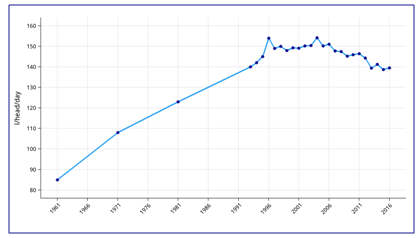
Figure 1: Trend in historic household consumption
This reduction is due to a range of factors including:
- Annual water efficiency targets by Ofwat for companies.
- The introduction of the water stressed area classification to extend metering.
- More focus on water efficiency in new homes.
- Establishment of Waterwise.
- Regulations for smaller toilet cistern sizes.
The current water resources management plans indicate a broadly similar rate of reduction in consumption over the next 25 years and the Ofwat report estimated that if the average demand reduction forecast for the next 10 years is maintained to 2065, the PCC in 2065 would be about 105 litres/head/day.
Stakeholders interviewed during the study thought overall that we should be more ambitious than this – most respondents though water use of less than 100 l/h/d was possible with 29% suggesting less than 75 l/h/d was achievable.
Stakeholder’s visions for making deep reductions focused on both practical measures such as introducing mandatory labelling for water using products, more efficiency technology, smart metering and tariffs, and ‘big’ picture’ issues such as how society regards and values water, which in turn could change behaviour.
This evidence was combined with information collected from a wide range of other sources to identify approximately 80 different measures for reducing household water use. The report demonstrates that many of the measures are available now and could deliver greater savings if implemented more widely. Examples include:
- Smart metering. Thames Water is currently rolling-out smart metering across its customer base. Smart metering is expected to deliver additional savings compared to conventional metering and provide a range of additional benefits to customers and companies alike.
- Propelair© ultra low flush toilet. A 1.5 litre flush toilet using displaced air and water. Currently aimed at commercial use but reduced noise and cost would make it viable for domestic use.
- Albion Water – Rissington development. Recycled water (green water) from wastewater is part of the scheme for new homes, for toilet use and garden watering.
- North West Cambridge Development. A community-wide rainwater harvesting (RWH) system to provide non-potable supply for toilets and washing machines for around 3,000 new properties.
- Mandatory water labels. Defra have recently commissioned a study to evaluate the costs and benefits of water labelling in England. The Australian Water Efficiency Labelling Scheme (WELS) has delivered estimated savings of 70 billion litres per annum between 2006 and 2013.
- Green Redeem customer rewards. Water companies are working with Green Redeem to provide customers with additional points-based incentives to save water.
- Southern Water: Target 100. Reducing consumption to 100 litres per person per day by 2040 using smart meters, home visits, personalised customer contact and incentives such as Green Redeem.
- Watersmart. This makes use of customer meter and other data to provide personalised bills and behavioural nudges (e.g. comparing use to local average).
- Recycling showers. Systems are on the market which are currently very expensive but collect, purify and recycle up to 90% of the water that would otherwise run to waste from domestic showers.
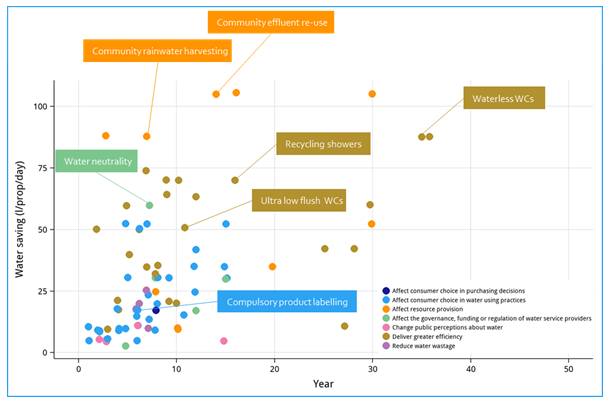 Figure 2: Measures for reducing household water use, potential impact in terms of water saving and time to widespread delivery
“Stakeholders agree that delivering deeper demand savings requires greater awareness of water scarcity issues in UK”
It’s difficult to define the costs of implementing measures like these, but the recent National Infrastructure Commission (NIC) report suggests that the cost of developing resilient systems, which includes a large proportion of demand management, is consistently less expensive that dealing with drought emergency. This report also suggests that comprehensive smart metering is at worst cost neutral.
Many stakeholders agree that delivering deeper demand savings requires greater awareness of water scarcity issues in the UK. Typical responses from the survey carried out in the project was that: “Myth busting is required as a national scale (“always raining, we get lots of rain, it should be a free resource, all responsibility should be with water companies”)”, and that “We need a ‘plastics’ moment so that the penny drops and people understand the value of water.” Part of the challenge here is that overall, the water industry has succeeded in providing a relatively low-cost, reliable service over the past 30 years, and that water supply issues are not at the forefront of people’s minds.
The report recommends nine ‘first steps’ to delivering deep reductions in household demand, as presented below.
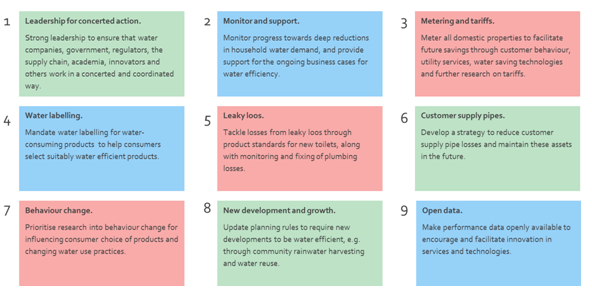
These steps can be taken immediately, and some progress is already being made, for example on the labelling of water using devices. Recent evidence submitted to the EFRA Committee inquiry into the regulation of the water industry also suggests that there is support to resolve the issues around customer supply pipes and some companies are starting to provide access to their demand data.
This is promising but substantial progress on these first steps will require greater leadership and co-ordination between a range of parties, from water companies to local government and from plumbers to academics. CIWEM, for example, suggests this could be achieved via a water saving forum with a clear mission and set of objectives to achieve its stated aims which could be held to account by Ofwat.
Development of water consumption targets, as promised in the Government’s 25 Year Environment Plan will also be an important step in the right direction. Targets that reflect the ambition set out in the Ofwat report would be welcome. Such targets could alter how water companies and others manage and plan for future demand by shifting the focus towards the measures that need to be implemented to achieve the necessary reduction in water use, and how these measures can be implemented most effectively. This in turn could lead to more collaboration between the key players, particularly when measures require action from others outside the water industry.
So the Ofwat report comes at a time when the role of demand management in delivering a resilient water resources system is in sharp focus. It describes the first steps that could set us on a path towards deep reductions in household water use, but it’s clear that these steps need to be taken whichever road we end up travelling.