
Water Resources West (WRW) has launched a new consultation on its Emerging Regional Plan for water resources - WRW is the only cross-border group and encompasses four major water companies, namely, United Utilities Water, Severn Trent Water, South Staffs Water and Dŵr Cymru Welsh Water.

One of the five regional groups established to develop regional water resources plans, the group provide strategic oversight and co-ordination of water resources across the river catchments of the West of England and the cross-border river systems with Wales
According to WRW, currently the region needs 5,550 Ml/d to supply households and businesses – the group is planning on the achievement of 50% reductions in leakage from the public water supply network by 2050 and for a reduction in per capita consumption to 110 litres/person/day.
However, even after accounting for leakage and per capita consumption reductions, WRW says that that an additional 215 Ml/d of new water to satisfy demand across public supply will still be required by 2031, with public water supply deficits are especially pronounced in the Midlands. The region will also need an additional 63 Ml/d by 2050, for non-public water supply sectors.
Following analyse of the types of supply options available to address the public water supply deficits the region is likely to face over a 60 year planning horizon (2025 to 2085) WRW has now drawn up a costed pool of feasible options. The Group is now seeking input from other stakeholders and sectors to refine the existing options, identify new ones and inform its decisions. WRW will then use the pool of feasible options to choose a draft preferred plan for further consultation in autumn 2022.
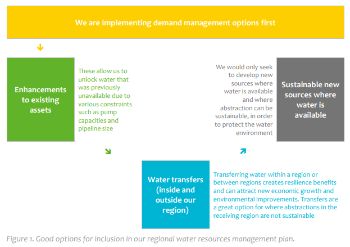
Overall, the group believes that the best supply options, where needed, are those which target enhancement of existing infrastructure in order to make the most of what is already available. It also sees transfers as good options, particularly when water is available and there are existing routes to enable the transfers.
WRW has also aligned its plan to the other regional plans to ensure that it has explored opportunities to contribute to national water resources resilience. This involved a process of reconciliation, where the trade-offs between transfers and other water resources supply options were explored. According to the Group, after accounting for its own needs and those of other regions, certain transfers emerged as flexible and resilient, including:
- River Severn to River Thames transfer scheme involving the movement of water from Vyrnwy, the North West and the Midlands to the South East of England by releasing water into the River Severn and then transferring it on to the River Thames.
- Transfer of water via the Grand Union Canal to the south-east of England.
The emerging plan sets out options to address water requirements for the following three regions:
MIDLANDS
Significant deficits arising in the 2040s - largely due to the need to protect groundwater levels and river flows.
Sherwood sandstone is an important aquifer that supports flow in many rivers which is also important for abstraction. However, flows in the rivers that rely on its groundwater do not always support good ecology, meaning abstraction from the aquifer must be limited.
A range of new water supply options will therefore be needed which are mostly focussed on enhancements to existing assets and transfers from other areas of the WRW region.
NORTH WEST
Deficits are smaller and some surplus water is available – as a consequence, fewer supply-side options will be needed compared to other areas of the WRW region.
However, the plan says supply options might be needed to support environmental enhancement in Carlisle in the 2040s. Transfers from the North West and Vyrnwy have been identified as good options for other areas in the WRW region as well as other regions. To avoid detriment to customers in the North West, enhancements would be made to support the transfer.
WALES
Deficits are very small and the Welsh areas included in WRW’s region are mostly in surplus, meaning fewer supply side options are needed when compared to other areas. While the plan will not include any transfers from Welsh Water, it does include a transfer from Vyrnwy reservoir situated in Powys. The reservoir is functionally part of the supply system for North West England and the abstraction is licensed to United Utilities.
In the future, some of the water from Vyrnwy reservoir may also be used to support other areas in England.
Deadline to comment on the plan and submit responses to the consultation is 28 February 2022.
Click here to download WRW's Emerging Regional Plan for water resources in full
Click here to access the consultation documents
Click here to access the consultation pages online