
How the UK plans, builds and operates infrastructure is likely to change dramatically in the next few years, according to the annual horizon scan report for 2023 from the Institution of Civil Engineers (ICE).

Infrastructure in 2023 brings together the predictions of civil engineers working in a wide variety of disciplines, from energy to flooding and transport to tunnelling.
The cost-of-living crisis and global economic pressures loom large in the report, which predicts that there will be less money for infrastructure projects and a greater emphasis on boosting productivity and using technology and data to drive efficiencies.
It also predicts that “huge strides” will be needed in the next five years if the UK is to meet its net-zero carbon commitments, with measurement of the whole-life carbon impacts of infrastructure playing a pivotal role.
Almost every section of the report calls for greater collaboration – both between civil engineers but also with those from other disciplines such as town planners, architects, environmental specialists and those working in the technology sector.
ICE’s Vice President David Porter said:
“Given our reliance on infrastructure, and the fact that it accounts for half of all energy-related carbon emissions, civil engineers have a crucial role to play in helping society to meet the climate change challenge...
“More extreme weather will require a greater focus on adaptation and resilience, and civil engineers can help with this. Their work can also help to ease some of the worst impacts of the cost-of-living crisis.”
Some of the key predictions in the report include:
Decarbonisation and energy: “Huge strides” in decarbonising infrastructure will be necessary as 2030 deadlines approach. There will be a focus on energy security and low-carbon sources as megaprojects like Sizewell C kick off, and as more renewable energy and cross-border connectivity schemes become viable.
Resilient infrastructure: A growing awareness of the vulnerability of our infrastructure as we experience new weather extremes such as the summer heatwave and possible flooding this winter. The government’s adaptation plan will be widely anticipated.
Sustainable drainage: A strong focus on water drainage systems (SuDS) in urban developments – especially if Schedule 3 of the Flood and Water Management Act is implemented, removing developers’ automatic right to connect to public sewers.
Many of the changes will require civil engineers to use new technology and to acquire new knowledge and skills, which may not have been part of their formal training – especially for those in senior positions.
The report contains contributions from ICE’s expert groups, known as Community Advisory Boards, across 10 areas of civil engineering, with each group contributing a chapter in the report.:
- data and digital
- decarbonisation
- driving productivity
- engineering fundamentals
- flooding
- geotechnical and structures
- low-carbon energy
- sustainable and resilient infrastructure
- transport and mobility
- water and sanitation
The ICE’s Low-Carbon Energy Community Advisory Board (CAB) – one of the expert groups that wrote the report – highlight that the share of UK energy supply generated from renewables is set to double by 2028.
Engineers will need to know about hydrogen, floating offshore wind, heat pumps and community-level renewables, both to implement projects but also to help policymakers to reach informed decisions.
The Data and Digital CAB say that digital twins, robotics, artificial intelligence and virtual reality are already here and can bring significant benefits. It calls for a national strategy for the digitalisation of the built environment, and for investors and clients to ramp up the sharing of data between projects.
The Decarbonisation CAB says that “whole-life carbon must become part of the mindset of civil engineers”. It calls for all public-sector projects to set short-range carbon quotas or budgets to set the pace of change, and welcomes the Built Environment Carbon Database which is aiming to store data on the carbon outputs of all kinds of construction projects.
Flooding – big changes are needed
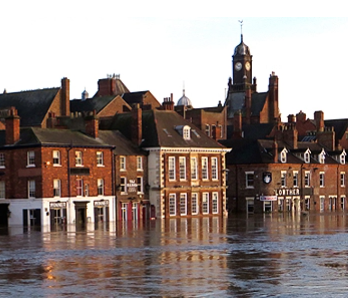
In the chapter focussed on flooding, the flood CAB says that big changes are needed and flags up a number of key reports from the past 12 months as offering a glimpse of the future for flood management in the UK.
Ensuring lessons are learnt from these works is a major task for the sector next year, the report says. It also emphasises that while sections of the industry have “long advocated a move away from alleviation targets” towards flood risk management strategies, recent weather events “show the urgent need for this to take place at greater scale.”
Natural flood management
According to the report, more implementation of natural flood management schemes on the ground will be important if the UK is to move forward in its attempts to tackle and cope with climate change.
The report draws attention to the Natural Flood Management Manual, published by CIRIA in May 2022 which urges decision-makers to protect, restore and mimic the natural environment and its hydrological processes.
“Highlighting tangible benefits will be crucial in persuading politicians and other gatekeepers of the merits of a scheme, as metrics that are based purely on flood risk reduction do not always achieve this aim.”
Commenting on sustainable drainage and Defra’s Storm Overflows Discharge Reduction Plan, the report refers to the pledge by Government ministers to decide on the “long-called-for implementation” of Schedule 3 of the Flood and Water Management Act before the end of 2022. If the clause is finally enacted, it will remove developers’ automatic right to connect to public sewers, and create a body to approve sustainable drainage systems (SuDS).
“The powers in the Flood and Water Management Act are critical if we are to harness the full power of blue-green infrastructure to protect homes and businesses from flooding while reducing our climate impact,” the report stresses.
The engineering experts also specifically refer to risk management in London and the Greater London Authority’s 2022 progress report looking at lessons learnt from the flash floods in the capital in the summer of 2021 which “laid bare the devastating impact of extreme weather on London’s critical infrastructure.”
ICE says a city-wide approach is clearly needed to manage flood risk in the most effective manner – an approach which also applies to other regions of the UK, and to the country as a whole.
“In seeking to manage flood risk in a changing climate, it isn’t only geographical boundaries that need breaking down. Too often we plan and develop infrastructure in silos, such as deciding which schools are to be replaced without considering flood risk and then having to close facilities when flooding occurs....
“The ICE Flooding community believes that resilience should be a more significant part of the funding and planning approval process for flood projects.”
Acknowledging construction cost inflation and the pressures this is putting on funding decisions, the community advises that adaptive planning should become the norm so that schemes can be signed off to progress in stages as budgets and climate reality allow.
Water industry's challenges brought into sharp focus in 2022

The chapter dedicated to water and sanitation says the water industry's challenges – including climate change, ageing infrastructure and image problems – were brought into sharp focus in 2022 and suggests that 2023 presents a significant opportunity to tackle them.
The report highlights the Environmental Audit Committee’s Water Quality in Rivers report published in 2022 which said water companies had “grown complacent” and “seem resigned to maintaining pre-Victorian practices of dumping sewage in rivers”.
Pointing out that "for some time, the water companies’ to-do list has been challenging," the report says:
“They are being asked to eliminate overflows from sewers, improve river quality, reduce leakages and increase the rate of asset replacement for water and sewer networks – all while reducing carbon and maintaining low prices. The pressure is ramping up in all of these issues, but this may in fact present a significant opportunity for civil engineers in 2023.”
According to the report, “the glaring need for change” prompted regulator Ofwat to launch its £200 million Innovation Fund, which was also set up to promote collaboration, something the ICE Water and Sanitation community believes “has not happened nearly enough since privatisation.”
Acknowledging that civil engineers “have not always been seen as leaders in the use of information technology”, the report suggests that this is changing with “the imperative to collect, analyse and intelligently use data to optimise asset performance.”
The water and sanitation CAB also believes that the sector increasingly understands the benefits of blue-green infrastructure, such as porous surfaces on streets and the use of retention ponds, and “traditional concrete tanks no longer being identified as the preferred solution.”
Systems thinking in the water sector
The report says in 2023 the ICE Water and Sanitation community plans to encourage engineers to look beyond familiar networks and collaborate with architects, town planners, municipal engineers and others to think more broadly about challenges, commenting:
“We need to take a systems-led approach that takes the whole water cycle into account: capturing it, using it intelligently, treating it and recycling it…...
“The preparation of business plans can enable the whole-system approach to move forward ahead of Ofwat setting price controls covering the water and sewerage sector for the latter half of this decade.”
Image problems - "sector has too often been criticised"

The water and sanitation CAB also makes the interesting point that the sector has too often been criticised “without consideration of how it has kept ageing assets working, serving the population during unprecedented climatic and economic times.” Instead, in recent years, headlines about water companies have often focused on leaks, discharges and hosepipe bans.
Suggesting that “showcasing success and innovation is a significant opportunity for the industry to change public opinion next year”, the report warns that being seen as “an inefficient, prehistoric, dirty place to work is also hampering recruitment of the much-needed next generation, while disillusioning experienced people who need to be retained.”
“As such, the Water and Sanitation community believes the water industry needs to showcase its environmental credentials and get positive stories into the public domain. In 2023 the community will be looking for opportunities to invite people to visit water infrastructure to understand the complexity of what the industry does in waste and water treatment. There is an imperative to promote better understanding of the sector.”
It goes on to suggest that as the UK moves closer to its 2050 net-zero carbon target – with the water industry aiming for net-zero operations by 2030 – the incentive to find different ways of working will increase, commenting:
“The water industry will have to make even more use of existing assets with smart interventions to tackle challenges without exceeding ultra-tight carbon and cash budgets.
“Organisations will need to think in broader geographic terms, coming together regionally and perhaps nationally to deliver systems-based solutions and look at water lifecycles.”
Click here to download the full report Infrastructure in 2023: A horizon scan of the year ahead for civil engineering