
James Stewart, head of Infrastructure UK (IUK) at HM Treasury, will step down from his role in February.
The news comes ahead of publication at the end of this month of the final report of Infrastructure UK’s investigation into the cost of civil engineering projects in the UK - said to cost “significantly more” than elsewhere in Europe.
Led by Terry Hill, Chairman of Arup, IUK Steering Group members include Ian Tyler, CEO of Balfour Beatty and Chris Newcome, CEO Anglian Water. Phil Stride, Head of London Tideway Tunnels at Thames Water sits on the Institution of Civil Engineers Independent Reference Group for the IUK cost review.
The aim of the review is to identify the scale of issues and range of possible actions that could be undertaken to reduce the out-turn cost of civils construction in the UK over the next five years and beyond. IUK published an update report at the end of October (to coincide with the publication of the Government’s National Infrastructure Plan).The update provided further detail of the investigation and the emerging findings.
International construction output statistics for civil engineering works
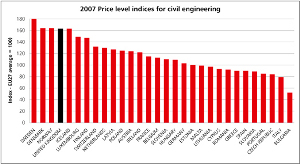
Source: Eurostat Construction Price Survey - 114/2008
According to the update, the initial results confirmed that the outturn costs of civil engineering infrastructure works in the UK are high in comparison with the rest of Europe. Out of a total of 30 countries the UK was near the top of the table - fourth highest after Sweden, Denmark and Norway.
Other key findings in the update report include:
- In some instances, higher relative capital costs in the UK can be attributed to greater intensity of use and enhanced design life of assets (where efficiencies in the cost of maintenance and renewal over the lifetime of the project balance against a higher initial cost), together with geographical factors such as the UK’s greater density of population. However, these factors do not fully account for the differences in cost.
- The general costs of labour, plant and raw material inputs during construction are broadly comparable with the UK’s main European peer group so it is unlikely these are driving UK costs.
- The evidence is indicating that higher costs for UK infrastructure are mainly generated in the early project formulation and pre-construction phases.
- In these early phases there are policy related factors (for example the UK planning and consents regime and regulatory standards) that impact on the whole infrastructure sector, including public and private sector investments.
- Stop-start investment - Lack of certainty of budget commitment to programme investment reduces efficiency, suppresses innovation and has a negative impact on industry’s appetite to invest in the UK. Where the private sector is given greater clarity of the pipeline, costs have been reduced. .
- Significant savings have been delivered in the utilities sector as a result of the private sector being able to offer greater continuity in the pipeline for infrastructure renewal and investment.
- Standards and regulation compliance - In the UK there is a complex web of planning, consents, regulation, process and standards, which absorb time and add considerably to cost. While these systems are designed to protect the rights of citizens and ensure high quality, safe infrastructure, the cost impact is considerable and is exacerbated by a risk-averse culture that can lead to over specification, excessive assurance, monitoring and scrutiny throughout the delivery process.
- Poor commissioning - Poor practice in commissioning is a major cause of inefficiencies in the specification, design, procurement and construction phases.
- Fragmented supply chain - The private sector construction industry for infrastructure in the UK is not structured to optimise efficiencies and maximise productivity through the supply chain.
Water sector is good example
The investigation is continuing to test the findings through further analysis and is developing conclusions for its final report. IUK is also developing recommendations for achieving cost reductions in the infrastructure sector. Interestingly, the UK water industry was cited as an example of efficiency in comparison with other areas.
The update said that the commissioning and procurement processes appeared to be more efficient in the private sector, both for bespoke projects and renewal programmes; especially where economic regulation had added to the downward pressure on costs and encouraged innovation. The example given was the development of standardisation and off site fabrication in some parts of the water industry.