
Ofwat has published its final guidance paper for the bioresources market setting out how the water sector regulator expects the sewerage companies to implement bid assessment frameworks for their bioresources activities.
The water sector regulator says that in order “to help achieve a functioning bioresources bidding market”, companies should aim to publish their final frameworks by the end of September 2022.
Ofwat expects the sewerage companies to use the guidance when developing their bid assessment frameworks to assess bids from other market participants. In terms of capacity and scope, the guidance covers all aspects of sewage sludge transport, treatment and disposal both for existing activities and enhancement expenditure for new capacity.
Currrently bioresources activities account for around £3 billion (6%) of the sewerage companies’ allowed revenue for the AMP7 2020-25 investment period.
Over recent years Ofwat has taken a number of steps to support the functioning of the bioresources market, including the introduction of a separate price control for bioresources activities during the 2019 Price Review.
Bioresources market is currently still “operating below its full potential”
However, the recent review of the bioresources market by Jacobs for Ofwat found that there are a number of barriers to its full development, while a separate market monitoring report provided further evidence that the market is operating below its full potential. Key issues included:
- Jacobs' bioresources market review report considers that companies’ procurement approach is a constraint as they typically take a streamlined approach to procurement which has the effect of restricting access to opportunities. Jacobs recommend companies undertake open procurement for new capacity.
- Jacobs' report considers that an ‘in-house’ bias created by companies' current organisation could hinder the market. It recommends the creation of a framework to assess third party capacity efficiency and the creation of a bid assessment framework.
Ofwat already requires companies to implement bid assessment frameworks to support the bidding market for water resources, demand management and leakage services. The regulator considers that “given the similar issues being addressed… much of the guidance for the water resources, demand management and leakage services bid assessment framework would be useful to apply to bioresources.”
However, Ofwat does not want the sewerage companies to “simply replicate” the water resources, demand management and leakage services framework in their bioresources bid assessment framework.
For the time being Ofwat has opted not to make the establishment of a common bid assessment framework a requirement on the basis that this would take longer to produce and it is unclear whether the benefits of this would be proportionate to the additional administrative burden this would create.
However, the guidance says the regulator will keep the issue under review and “may introduce greater commonality requirements if the bid assessment framework is not working as intended in facilitating third party provision.”
Separation of assessment teams is important measure to address risk of conflicts of interest
Ofwat has also opted to keep its proposal that where a third-party bid is assessed against a sewerage company's in-house solution, the team assessing the bids should be completely separated from the team that designed the in-house solution. Both Anglian Water and Yorkshire Water had raised concerns with this approach on the basis that it would be difficult to achieve complete separation, “especially for technical criteria as bioresources teams are often small and specialised.”
The guidance says: “separation of teams is an important measure to address the risk of conflicts of interest.”
Where a third-party bid is assessed against a company's in-house solution, the expectation is that the team assessing the bids would be completely separated from the team that designed the in-house solution, with companies' procurement functions in the wholesale part of the business overseeing the process to ensure it is “carried out appropriately.”
Sewerage companies must not artificially narrow competition or distort market competition by abusing a dominant position
The regulator has taken particular care to emphasis the obligation for the companies to comply with competition law, in particular that during the tender process companies should ensure that they do not:
- artificially narrow competition (where the design of the procurement is made with the intention of unduly favouring or disadvantaging certain or all parties);
- distort competition in the market by abusing a dominant position (e.g. through unfair prices or other unfair trading conditions); or
- facilitate collusion between third parties by disclosing confidential bid information.
Bid assessment frameworks must show “clear commitment” to three key principles
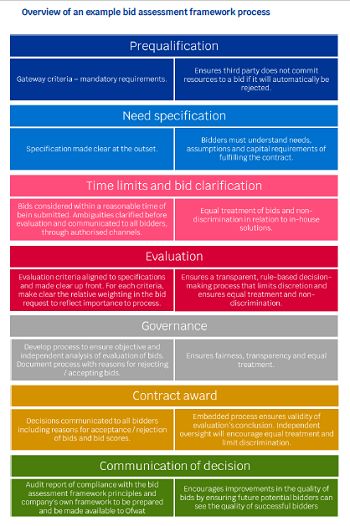
The guidance also states that the companies should produce a bid assessment framework that shows a clear commitment to the following three key principles:
Transparency - the process for selecting third parties and award criteria should be transparent to all bidders to ensure confidence that companies will not favour their own in-house solutions or allow unfair advantage to other bidders. “This in turn should help to stimulate third parties to make bids.”
Equal treatment / non-discrimination – all potential suppliers should have an equal opportunity to compete to provide the service and there should be objective comparison of tenders, which should also apply to the consideration of bids against a company's in-house solution.
Proportionality – companies should ensure that the way in which they assess bids and design tenders is proportional to the service that is being procured. For example, bidders should not be discouraged from bidding for a relatively small contract because of the specification of a disproportionately large number of criteria.
Sewerage companies "should look to support bidders at pre-qualification stage"
The regulator also says the companies should look to support bidders at the pre-qualification stage.
Ofwat expects companies to publish bid evaluation criteria alongside an invitation to submit bids and to outline sufficient details of the overall process, including timescales, together with making “efforts to support bidders in understanding what information they must provide as part of a bid. This is particularly the case for small or inexperienced firms for who submitting bids may be a costly and time-consuming process,” the guidance says.
In addition, Ofwat is recommending that the bid assessment frameworks must include an appropriate appeals and complaints process for third parties, including the opportunity for a bidder to appeal at each stage of the bidding process. The regulator also wants companies to provide feedback to unsuccessful third parties as to why their bid was rejected.
Commercially sensitive information should be subject to “confidentiality ring” with restricted access
The guidance stresses that the application of non-discrimination within the process is critical to the integrity of the bid assessment framework and that any commercially sensitive information should be subject to a “confidentiality ring with restricted access.”
According to Ofwat, non-discrimination will provide reassurance to third party bidders that any commercially sensitive information is protected and cannot be used as an advantage to the in-house solution development team, “either at the time of the bid or in the future.”
“This will prevent conflicts of interest, avoid distortion of competition and safeguard against misuse and the perception of misuse by the in-house team to gain an unfair advantage” the guidance says.
To avoid distortion of competition and ensure equal treatment of all bidders, Ofwat expects the sewerage companies to take appropriate measures to prevent, identify and remedy any conflicts of interest arising from the procurement process.
In terms of contract risk, the regulator wants companies to make clear the information needed from bidders surrounding operational risk and include this within the pre-qualification stage of the bid assessment process. The guidance states:
“The nature of the bioresources industry means that sewerage companies need to be confident that the sludge for which they hold responsibility can be properly treated and disposed of at all times. Maintaining operational resilience is therefore a key concern for companies.”
According to Ofwat, earlier sector engagement had suggested that sewerage companies' concerns around the continuity of supply from third parties was a key issue hindering the bidding market.
Market participants had also suggested that these concerns may have led to bids being rejected without adequate explanation.
Where bids are rejected on the grounds of risk, Ofwat expects the companies to provide feedback to bidders in line with the principle of transparency.
The regulator is also keen to ensure that bidders are not prevented from complying with bid requirements due to lack of access data held by companies. The guidance points out that if sewerage companies refuse to allow access to relevant information, third parties would be disadvantaged and that the companies “must not unreasonably withhold information that bidders may need in order to fulfil bid requirements.”
Timing - companies should aim to publish final bid assessment frameworks by end September 2022
Ofwat’s timeline for implementation includes an expectation that companies would consult publicly on a draft of their bid assessment framework.
However, Ofwat has decided not to set out who companies should consult with or how they should advertise their consultations about their proposed frameworks on the basis that providing detailed guidance for how consultations should be carried out risks companies' engagement becoming a 'tick-box exercise'.
In terms of timescale, Ofwat says the companies should comply with the bid assessment framework guidance “as soon as reasonably possible” and that “to help achieve a functioning bioresources bidding market” companies should still aim to publish their final bid assessment frameworks by the end of September 2022.
Where possible, the regulator also wants the companies to make use of their bioresources bid assessment frameworks to inform their PR24 business plans.
Ofwat has reserved the right to keep under review whether to formally assess companies' compliance, saying that if companies exhibit “consistently poor practice” it may take steps to address this. In the first instance the regulator could look to highlight poor practice within its annual bioresources market monitoring report.
However, if it still had concerns it would consider further options, such as assessing compliance at PR24.
Click here to download Ofwat’s Bioresources bid assessment framework – final guidance