
With a new report published last week from the House of Commons Environmental Audit Committee on PFAS recommending ever-tighter regulatory restrictions, a timely article from Dale Foster and Adrian Heneghan at HUBER Technology discusses how sludge drying technology has a key role to play in the water companies’ toolkit.

Dale Foster and Adrian Heneghan: Due to the reliance on Anaerobic Digestion Sludge Drying technology in the UK has been on the back-burner for a couple of decades. However, in recent years we’ve seen growing uptake of our sludge drying equipment by water utilities, municipalities and industrial manufacturers across Europe and beyond.
In the light of the new EAC report on PFAS calling for ever-tighter regulatory restrictions on how the presence of “forever chemicals” should be tackled, this is a real opportunity for the water companies to get on the front foot in how they deal with sewage sludge.
Around 93% of sludge is recycled to agricultural land as biosolids – current Government policy considers biosolids recycling to agricultural land in most circumstances to be the Best Practicable Environmental option. The Environment Agency’s strategy for safe and sustainable sludge use says the EA wants sludge to continue to be used as a beneficial resource.
However, the EAC’s report will no doubt reinforce continuing concerns over two issues the industry is facing – namely, ever-tighter constraints in applying sludge to land and the potential need for a significant increase in capacity to store treated sludge.
These concerns were flagged up in a prescient report by Jacobs – the Bioresources Market Review. Results of a survey included in the report said that when asked to rank a number of issues from the greatest to the least, “in terms of their ability to affect a long-term capacity transactions as a whole”, 10 water company respondents chose landbank (availability of land for biosolids spreading) and environmental regulation as their top two risks.
The practice of spreading sewage sludge to agricultural land is now rising further up the agenda in both the minds of the public and at a regulatory and political level. Recent experience on stormwater discharge overflows shows that highly effective and high-profile media coverage and the impacts in the court of public opinion ultimately led to the tighter restrictions which require total compliance of all stormwater overflows by 2050. It is undoubtedly a prime example of what could follow with ‘sludge to land’ being viewed in the same way. The ultimate worst case scenario would of course be the potential total ban on sludge to land.
To date the UK’s track record of sludge drying and thermal destruction has somewhat lagged behind with our experience on the continent. However, the water sector undoubtedly understands the need to get ahead on this issue – and to be seen to be taking active steps – and we are now seeing definite signs that this is changing.
So what are the advantages that sludge drying technology can bring to bear?
For the water companies, first and foremost, sludge drying offers significant benefits in terms of reducing operational costs.
Uptake is now a material consideration driven by growing concerns over reduction in land banking facilities and the tightening of further restrictions on land spreading, already currently limited to the winter and summer growing seasons.
At the very least, during AMP8 they will need to consider how to increase their storage capacity of dewatered sludge because of potential bottlenecks in terms of disposal to land with all the attendant issues surrounding the construction of bigger storage facilities, and managing transport and logistical factors.
Key to this will be the volume of sludge which is being generated day in, day out which needs treatment.
Most thermal sludge dryers will be taking sludge in at a balance of around 25% dry solids/ 75% liquids - basically, 75% water.
In contrast, when the sludge is processed using the HUBER Belt Dryer BT you are looking at 90% dry solids – a massive 75% reduction in volume compared to a standard dryer.
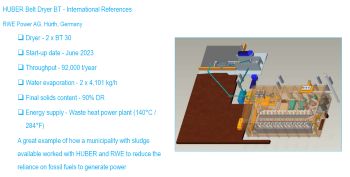
Purely in terms of transportation and logistics alone, this represents a significant reduction in costs. Likewise, it is also accompanied by a similar reduction in storage requirements. The ability to store this reduced level of volume in hippo bags stacked up in bays ready to be able to go to land or for use as an alternative fuel when it is appropriate will not be lost on the water companies contemplating the prospect of ever- tighter regulatory controls.
The HUBER Belt Dryer BT represents state-of-the-art technology of sewage sludge drying with maximum energy efficiency. The resulting output in terms of dry granulate produced by the dryer can be used both as fuel and fertiliser – increasingly relevant in the light of current Ofwat-sponsored pilot projects exploring what can dried sludge be used for. HUBER Belt Dryer BT | HUBER Technology
Reducing the water content means they can get storage capability needed to much lower levels – a considerable advantage if tighter regulation has the potential to require them to make provision for sufficient levels of storage space for extended periods.
In practical terms this offers the opportunity for water companies to put the dried product to an alternative use if further restrictions on spreading to land as fertiliser come into play.
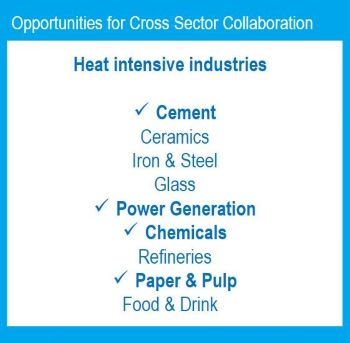
This is already the case in Europe, where municipalities and industrial users alike, particularly in heat - intensive industries, have been quick to take advantage of the opportunities for cross-sector collaboration on offer. To mention just a few, these include:
Key drivers for this uptake, which continues to expand across Europe, include:
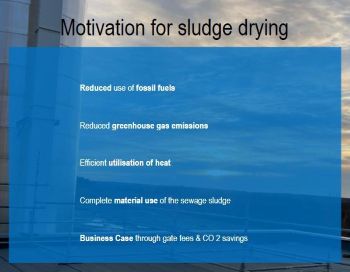
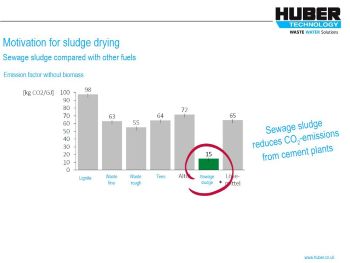
This product is already being used on the continent in a positive way to generate energy. To take just a couple of examples, HUBER’s drying technology has been put to use and incorporated into the cement production process at the Heidelberg cement plant – Geselke Drying of sewage sludge in Heidelberg cement plant.
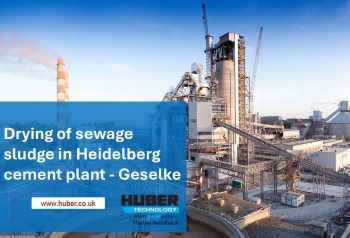
In addition to reducing their operational costs, this is also helping to decarbonise the cement production facilities and offers them a viable alternative to fossil-based fuels.
Heidelberg Cement built a sludge drying plant and took in all the sludge from the local municipalities, enabling them to both charge a gate fee for accepting the sludge, which they then use as an energy resource to fire their cement production kilns.
BASF Chemicals have also done a similar exercise with a local municipal water company.
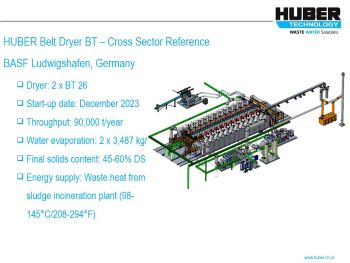
These possibilities exist in energy-intensive industries whose own production processes also generate significant amounts of sludge, whether they’re paper mills or chemical manufacturing plants with their own onsite wastewater treatment plants. They can likewise take in more sludge from other sources which can be used to contribute to the heat energy balance for their own production.
The current energy situation globally has undoubtedly brought into sharp focus the need to lessen the current high level of dependence of fossil-based fuels.
At both country and organisational level the ability to be flexible and pivot quickly to access alternative sources of energy as feedstock for energy generation is becoming increasingly urgent - and cross-industrial sector collaboration will play an ever-greater role.
And unlike other big renewable infrastructure projects which take months, if not years of planning alone prior to construction, together with significant amounts of investment, the infrastructure is already in place and the technology is also readily available.
HUBER has already undertaken a considerable number of these projects in Europe – and we’ve built up a corresponding depth of expertise, experience and specialist capabilities.
We’re always happy to have an informal discussion about the issues. We’ll be at the following exhibitions and conferences over the next four months so you can come and talk to us in person
IFAT, Munich – 4th-7th May, Water Equipment Show at Telford International Centre – 14th May, Utility Week Live 19-20th May NEC Birmingham and the European Wastewater Management Conference & Exhibition at Telford International Centre 16-17th June) or email us to set up a meeting.
We’ll also be looking at sludge drying as part of our upcoming free-to-attend webinar in September on sludge treatment – email This e-mail address is being protected from spambots. You need JavaScript enabled to view it if you’d like to attend or want more information.
And if you want to contact us directly please email/ phone:
This e-mail address is being protected from spambots. You need JavaScript enabled to view it Mobile: +44-7980-316059
This e-mail address is being protected from spambots. You need JavaScript enabled to view it Mobile: +44-7540-667094