

Leading environmental organisation WWF is warning that the future of the critically endangered Mekong River Irrawaddy Dolphin is threatened by the 11 proposed hydropower dams along the Mekong.
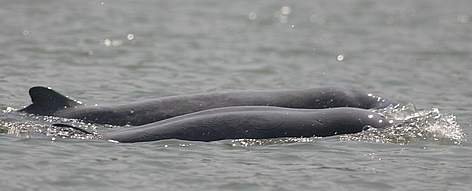 Whilst years of effective conservation work has slowed the rapid rate of decline, the proposed mega-dams could deal a crushing blow to the Mekong’s dolphins, according to WWF.
Image:The Irrawaddy dolphin in the Mekong River.
The Don Sahong Dam site is less than two kilometres upstream from a deep river pool, which contains Laos’ last four Irrawaddy dolphins. Blasting alone could seriously damage their sensitive hearing. Further downstream in Kratie, a much larger population of dolphins is also threatened by the dam that could drastically reduce its food supply.
A new population survey by WWF and the Cambodian government found that the annual rate of decline has slowed from approximately seven per cent per year in 2007 to less than two per cent in 2015. This is the result of years of work by the government and WWF to protect their habitat and remove illegal gill nets, a major cause of dolphin mortality.
WWF says the dams have the potential to irrevocably disrupt fish migration, which would also endanger the world’s largest inland fishery and the main source of protein for the region’s 60 million people.
One of these – the Xayaburi Dam in northern Laos – is almost complete, while construction on another mega dam on the Don Sahong channel in southern Laos is expected to begin before the end of the year by Malaysia’s Mega First Corporation Berhad.
John Barker, Head of Programmes at WWF-UK commented,
“We still have a long journey ahead of us before being able to celebrate thriving populations of the iconic Irrawaddy dolphin in the Mekong. These dams will hugely damage years of conservation work and could have irreversible effects on this national treasure as well as threatening the food security of millions of people.”
Sam Ath Chhith, Country Director of WWF-Cambodia said,
“We need to re-double our efforts to reduce the mortality rate by protecting the dolphins from illegal gill net fishing and by ensuring that the destructive Don Sahong Dam and others like it are not built. The dam will have negative impacts on the entire Mekong River ecosystem all the way to the delta in Vietnam: it cannot proceed.”
The latest results also showed that the number of juvenile dolphins reaching adulthood has vastly improved giving further hope for the survival of species.
The population of the Mekong Irrawaddy Dolphin was estimated at no more than 200 individuals in 1997. Their numbers fell to 127 in 2005, to 93 in 2007 and to 85 in 2010.
The population survey was conducted along the main channel of the Mekong River from Kratie Township in Cambodia’s Kratie province to the Khone Falls complex in Champassak province in Laos and back again – a total distance of 380 km.
 ABB has launched AquaMaster+™, a digital platform for smart water network management, designed to help water utilities monitor, analyze and manage their water networks, preventing pipeline water losses and optimizing operations.
 Craig Nienaber, Business Development Manager for Safe Access Solutions (SAS) at HUBER Technology, explores why the company is seeing a growing level of interest in its safe access solutions for critical infrastructure providers, including their application in wastewater treatment assets.
 Albion Water, the first NAV (New Appointment & Variation) to have been established in1999 and now under the ownership of SDS Water Group, has appointed Andy Holland as its new Director of Business Development.
 UK water companies are invited to join an upcoming webinar which will explore how the sector can take indirect potable reuse (IPR) from concept to full-scale operational reality.

 Southern Water has released film and images showing what it’s like to walk inside Hampshire’s expanded Yew Hill underground reservoir for the very last time, before it gets filled with water.
 Hear how Scottish Water has completed its £235 million Ayrshire Glasgow Resilience Project - customers across Greater Glasgow, Ayrshire and East Renfrewshire will now benefit from a more secure and resilient water supply.
 Hear how United Utilities is accelerating its investment to reduce spills from storm overflows across the Northwest.