

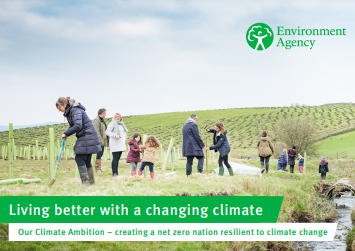
In a new report to Government published today - Living better with a changing climate - the Environment Agency is warning of more extreme weather leading to increased flooding and drought, sea level rises of up to 78 centimetres by the 2080s, and public water supplies needing more than 3.4 billion extra litres of water per day by 2050.
It has urged governments, businesses and society to embrace and invest in adaptation, rather than living with the costs of inaction.
With less than 3 weeks to COP26, Environment Agency warns that adaptation – becoming resilient to the effects of climate change – is just as vital as mitigation.
The climate emergency can only be successfully tackled through greater focus on adapting to the inevitable climate impacts that we are already seeing, the Environment Agency is warning today as it urges world leaders to step up to the challenge at COP26.
The Agency has welcomed the UK Government’s focus on adaptation as well as mitigation, and the fact that climate adaptation is one of the Summit’s 4 key goals, but urged that more action is needed at a global level to protect the billions of lives and livelihoods that are at risk.
Launching the report, Emma Howard Boyd, Chair of the Environment Agency, said:
“Adaptation action needs to be integral to government, businesses and communities too and people will soon question why it isn’t – especially when is much cheaper to invest early in climate resilience than to live with the costs of inaction.”
“With that in mind, it is deeply worrying that adaptation is in danger of being grievously undercooked at COP26. Not by the UK government, but by the world at large.”
The message comes in the Environment Agency’s third adaptation report, submitted to the government under the Climate Change Act.
- Even with a 2°C temperature rise compared to pre-industrial levels, key projections within the report include:
- Winter rainfall is expected to increase by approximately 6% by the 2050s and by 8% by the 2080s, compared to a 1981-2000 baseline.
- Summer rainfall is expected to decrease by approximately 15% by the 2050s compared to a 1981-2000 baseline.
- London’s sea level is expected to rise by between approximately 23 centimetres by the 2050s and 45 centimetres by the 2080s.
- River flows will be more extreme. Peak flows are expected to be up to 27% higher in the 2050s, while in the summer months river flows could be 82% lower by as soon as 2050.
- Public water supplies are expected to require more than 3.4 billion extra litres of water per day if no action is taken before 2050.
Not technically and economically viable to protect every community
The report also sets out 5 climate “reality checks” to make the case for urgent action on adaptation:
The Environment Agency alone cannot protect everyone from increasing flood and coastal risks: rising sea levels and extreme winter rainfall will mean it will not be technically, socially, and economically viable to protect every community. Instead, alongside constructing and maintaining defences, we must help communities learn to live with risk, minimise damage, and return to normal life quickly.
Climate change makes it harder to ensure clean and plentiful water: existing issues with water stress will be exacerbated by climate change bringing altered temperature and rainfall patterns. Measures to tackle these pressures are underway, but a strategic approach to water management and faster progress on improvements are needed.
Environmental regulation is not yet ready for a changing climate: climate change is increasing the impact of environmental incidents, for example lower river levels means pollutants diffuse slower and have a greater impact. It is vital that environmental policy and legislation keeps pace with the escalating challenge to allow us and other regulators to protect the environment.
Ecosystems cannot adapt as fast as the climate is changing: industrialisation and urbanisation have left the UK as one of the most nature-depleted countries in the world, and climate change means wildlife in England will continue to be altered. We must recognise importance of natural ecosystems in supporting life (including our own) in our health and wellbeing. Nature must be the essential foundation of development, rather than being seen as an impediment.
More and worse environmental incidents: both natural and man-made environmental incidents will be made worse by climate change. This will place an increased burden on emergency response, and divert resources from other activities.
The report highlights how the Environment Agency is working with government, businesses and communities to prepare for the impacts of climate change, including delivering a record £5.2 billion programme of new flood and coastal defences over the next 6 years.
The report says that while the risks are serious, they can be addressed by early action, and the report also sets out how the Environment Agency is meeting the challenges.
This includes:
- Working with government, businesses and communities to implement the FCERM Strategy and its vision to create a nation ready for and resilient to flooding and coastal change up to 2100.
- Working with water companies and Ofwat on the National Framework for Water Resources, which sets out how the Agency will address future challenges to water supply.
- Helping to deliver the £10 million Natural Environment Readiness Fund, helping to support projects in attracting private sector finance into investment in the natural environment.
- Focusing on nature based approaches, restoring and creating peatlands, wetland and other habitats to create climate-resilient habitats for wildlife, reduce flood risk, improve water quality and improve access to greenspace for people.
- Using its role as a regulator to help businesses understand and reduce their climate impact and prepare for the future.
Deaths due to flooding "will happen in UK sooner or later"
Emma Howard Boyd continued:
“Significant climate impacts are inevitable. We can successfully tackle the climate emergency if we do the right things, but we are running out of time to implement effective adaptation measures. Our thinking must change faster than the climate.
“Some 200 people died in this summer’s flooding in Germany. That will happen in this country sooner or later, however high we build our flood defences, unless we also make the places where we live, work and travel resilient to the effects of the more violent weather the climate emergency is bringing. It is adapt or die. With the right approach we can be safer and more prosperous. So let’s prepare, act and survive.”
Click here to download the full report Living better with a changing climate
 Enpure Ltd and Clean TeQ Water Ltd have announced a collaboration agreement to bring Clean TeQ Water's Moving Bed Ion Exchange-based nutrient removal technologies to water utilities across the UK.
 Near-real-time microbial monitoring of wastewater discharge and bathing waters is now possible thanks to the BactoSense ID solution created by Swiss-based bNovate Technologies.
 ABB has launched AquaMaster+™, a digital platform for smart water network management, designed to help water utilities monitor, analyze and manage their water networks, preventing pipeline water losses and optimizing operations.
 Craig Nienaber, Business Development Manager for Safe Access Solutions (SAS) at HUBER Technology, explores why the company is seeing a growing level of interest in its safe access solutions for critical infrastructure providers, including their application in wastewater treatment assets.

 Southern Water has released film and images showing what it’s like to walk inside Hampshire’s expanded Yew Hill underground reservoir for the very last time, before it gets filled with water.
 Hear how Scottish Water has completed its £235 million Ayrshire Glasgow Resilience Project - customers across Greater Glasgow, Ayrshire and East Renfrewshire will now benefit from a more secure and resilient water supply.
 Hear how United Utilities is accelerating its investment to reduce spills from storm overflows across the Northwest.