
In its latest water resources update, Bristol Water has reported that reservoir levels have now fallen to 62%.
Reservoir levels have dropped by 1% over the week and stand at 62%. The company’s biggest reservoir, Chew Lake, is 11% lower than at the end of August 2010 and stands at 55% full, compared to 66% in August 2010. Blagdon Lake has dropped to 59% full and Cheddar Reservoir has held at 74% full. The Barrow Reservoirs are 88% full.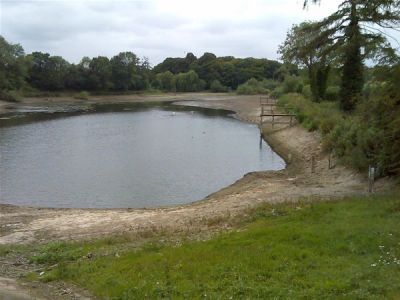
Chew Magna reservoir August 16th
The company’s small, five acre local Chew Magna reservoir is now virtually empty – last week BW Fisheries staff mounted a rescue exercise to capture stranded trout and move them to the safety of Chew Lake itself.
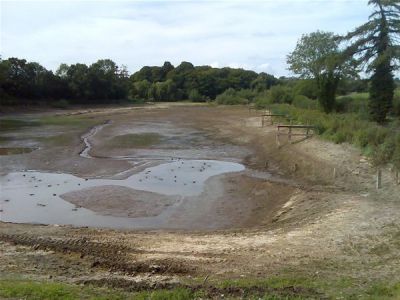 Chew Magna reservoir August 22nd
Bristol Water’s water resources have been severely impacted by a sustained lack of rainfall over many months. In the Mendips, the catchment where the rainfall feeds the company’s reservoirs, rainfall in March was 16.5 mm, or just 22% of the average. It was the driest March for more than 50 years with net reservoir inflow was 35% of the average. The situation barely improved in April with rainfall of 19 mm, or 34% of the average. Net reservoir inflow in April was only 900 million litres, less than 20% of the average, reflecting the increasingly dry conditions.
Although rainfall levels have gradually improved since May, with higher than average rainfall in both June and July, and close to the average in August,, the company still has concerns over future water supplies
Last year, Mendip rainfall was persistently -- and, at times, significantly -- below average for month after month after month, with seven months of significantly below average rainfall locally. In statistical terms for BW's own area, December 2010 was one of its driest ever months.
Bristol Water said the real issue for reservoir storage was annual rainfall for January to December 2010. This was exceptionally low, the third lowest in the last 100 years with only 1921 and 1933 being lower (both famous drought years). The rainfall drives the inflow to a significant extent.
Net reservoir inflow in May 2011 was effectively zero --the lowest inflow for May in the past 50 years.
Bristol Water is not totally reliant on the Mendip reservoirs for resources - typically, around 50% of supply comes from the reservoirs with the other 50% coming from a combination of the Sharpness Canal and groundwater sources, such as springs and boreholes.
Earlier in summer 2010, as part of its strategy, the company reduced the amount of water taken from the Mendip sources as much as practicable, replacing this with pumped transfers of River Severn water from Sharpness. Bristol Water repeated the exercise this year and has steadily maximised the use of all its northern sources.
However, despite the significant shortfall in resources, at the moment Bristol Water says that it is not short of water and is not currently planning any water use restrictions. Bristol Water is now awaiting the normal refilling of the reservoirs with autumn and winter rains.