

Ofwat has begun to scrutinise water companies’ business plans for the next price review period (2020-2025), with the regulator due to publish its initial determination for each company’s plan in January of next year.
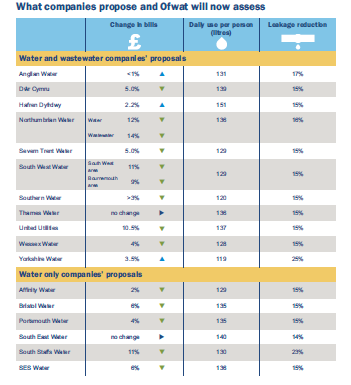 Business plan proposals outlined by the 17 water and wastewater companies include:
- Bill changes between 2020 and 2025 ranging from an increase of 3.5% to a decrease of 14%;
- A reduction in daily household water use per person to as low as 119 litres, compared to a current sector-wide average of 141 litres; and,
- A commitment from 16 companies to meet Ofwat’s 15% leakage reduction challenge, with 2 companies promising to cut leakage by more than 20%.
When it publishes its initial assessment of each company’s plan on 31 January 2019, Ofwat will categorise companies’ plans according to the level of quality, ambition and innovation they have demonstrated.
The best plans could benefit from incentives through the price review process, while those that fall short will face closer scrutiny and interventions and could receive lower returns.
Ofwat will make final decisions on the services water companies must deliver and limits on the prices they can charge customers in December 2019.
Ofwat Senior Director, David Black said:
“Now that water companies’ business plans have been submitted, we’ve entered the next critical phase of our price review process. Over the coming months, we’ll be scrutinising each and every plan in detail to ensure they are robust enough to deliver a high quality, affordable and resilient service to customers in the years 2020-2025 and beyond.
As we test each company’s plan, we’ll be looking for evidence of ambition and innovation and crucially, we’ll want to see customers and the environment put to the fore as never before.”
 Ray Moulds, Sales Director at Flood Control International, takes a look at how automated sliding floodgates are supporting secondary containment at water and sewerage company sites.
 With the UK government demanding a 50% reduction in storm overflow spills by 2029, the era of reactive management is over. Speaking in the House of Commons on 21 July 2025, then environment secretary Steve Reed said, “This Government will cut water companies’ sewage pollution in half by the end of the decade.”
 ERG, the leading supplier of odour control systems and industrial gas cleaning & thermal systems, has been awarded the coveted King’s Award for Enterprise.
 Welsh Water’s new artificial intelligence-driven tool, ORAI, has been shortlisted for three categories at the prestigious British Data Awards 2026 – underscoring the company’s commitment to using cutting-edge technology to deliver better outcome for customers.

 Hear how Scottish Water has completed its £235 million Ayrshire Glasgow Resilience Project - customers across Greater Glasgow, Ayrshire and East Renfrewshire will now benefit from a more secure and resilient water supply.
 Hear how United Utilities is accelerating its investment to reduce spills from storm overflows across the Northwest.
 Find out more about the remarkable career opportunities on offer at WSP - scroll down to watch the inspirational video.