

A new report is warning that London is facing a water crisis, with the capital at an increased risk of flooding and drought due to London’s changing climate, loss of green space, growing population, and aging water pipes.
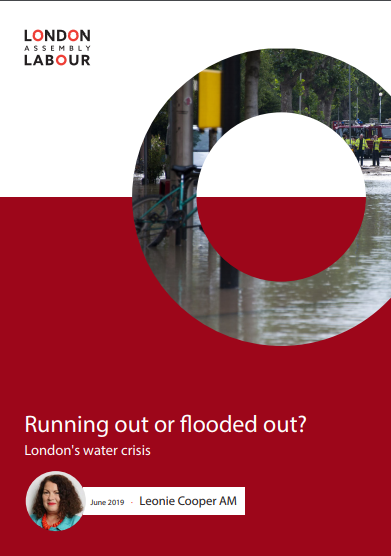
The report - Running out or Flooded out? – prepared by Labour’s London Assembly Environment Spokesperson, Leonie Cooper also says that London’s water suppliers have failed to tackle leaks, with 26,000 incidents of burst pipes in just over four years.
In her report, Leonie Cooper AM urges the Mayor of London to put pressure on water companies to protect and invest in London’s water supply, including through the replacement of aging pipes, to halve the number of leaks by 2050.
The data acquired by Leonie Cooper from London’s two biggest water suppliers – Thames Water and Affinity Water – shows that there were 26,082 burst pipes in London between 2015 and the end of February 2019.
According to her report, the capital’s changing, and increasingly extreme, climate has put London’s water supply under pressure in recent years, with aging pipes unable to cope. Floods across south London in early 2018 were the result of extreme freeze-thaw weather during the ‘Beast from the East’, with widespread flooding and water outages.
Following warnings from the Environment Agency that the South East of England could run out of water in the next 25 years, Leonie Cooper has also urged the Mayor to raise awareness amongst Londoners about what they can do to save water. Londoners are estimated to use on average 149 litres of water per person per day - 5% higher than the national average. The report calls on Sadiq Khan to run a campaign to encourage the take up of water meters which have been shown to reduce usage by 30-40 litres per family per day.

It also calls on him to lobby the Government to conduct an assessment of the costs and benefits of bringing forward the construction of a new Thames Barrier to protect Londoners against faster than anticipated sea level rises. The Mayor’s Risk Register ranks flooding as one of the highest risks, both in terms of likelihood and the level of damaging impact.
On drought, the report highlights a warning by Thames Water that a severe drought could cost London’s economy £330 million per day and would have severe economic, social and environmental consequences.
With the threat of drought increasing, Ms Cooper says construction of the proposed reservoir at Abingdon, Oxfordshire, which would create extra storage for millions of litres of water for London, must be accelerated to 2035 – two years sooner than planned.
The report says that Mayor should call upon OfWat and the Environment Agency to grant permission at an early stage for the Abingdon Reservoir construction, and Thames and Affinity Water to construct the Abingdon Reservoir as soon as is practicable, with completion no later than 2037.
The report also warns that London’s growing population is putting pressure onto the capital’s sewerage system, causing pollution to be leaked into the River Thames and burst pipes. It also points to the loss of green space, with water unable to escape impermeable surfaces contributing to flooding, which is now considered one of the biggest risks to London’s resilience.
It also recommends that the Mayor should lobby water companies and OfWat to work effectively together to ensure a higher level of investment in water supply infrastructure.
Labour’s London Assembly Environment Spokesperson, Leonie Cooper AM, said:
“Water is essential for people to function, and it is essential for our city to function.
“Given we sit right on top of the River Thames and that England is known globally for its rain, it’s easy to make the mistake of believing we have an endless water supply – but the opposite is true.
“With London under the looming threat of both flooding and drought, we simply cannot afford to wait before taking action to protect our water supply.
“Whilst the Mayor has no real legal powers in relation to water resources, he can use his influence to ensure water companies protect and invest in vital infrastructure. With the rate at which we’re seeing leaks across London, it’s clear suppliers need to up their game.
“As Londoners, we can also help by paying closer attention to the amount of water we’re using and trying to cut back wherever possible.”
Other recommendations in the report include:
- The Mayor should work with water companies to roll out a water efficiency retrofitting pilot and water meter installation programme across London.
- The Mayor should support sustainable water management in London by convening a working group with key stakeholders to develop and implement joint action plans on leaks, sustainable drainage, and customer communication.
- The Mayor should collaborate with water companies in London to conduct an awareness raising campaign to help Londoners save water.
- The Mayor should require developers to select the most water efficient appliances for inclusion in new developments and install greywater recycling.
Click here to download Running out or flooded out? London's water crisis
 Uniwater has acquired Hy-Ram Engineering, a specialist in tooling, products and hire for the water sector, based in Mansfield, England.
 Enpure Ltd and Clean TeQ Water Ltd have announced a collaboration agreement to bring Clean TeQ Water's Moving Bed Ion Exchange-based nutrient removal technologies to water utilities across the UK.
 Near-real-time microbial monitoring of wastewater discharge and bathing waters is now possible thanks to the BactoSense ID solution created by Swiss-based bNovate Technologies.
 ABB has launched AquaMaster+™, a digital platform for smart water network management, designed to help water utilities monitor, analyze and manage their water networks, preventing pipeline water losses and optimizing operations.

 Southern Water has released film and images showing what it’s like to walk inside Hampshire’s expanded Yew Hill underground reservoir for the very last time, before it gets filled with water.
 Hear how Scottish Water has completed its £235 million Ayrshire Glasgow Resilience Project - customers across Greater Glasgow, Ayrshire and East Renfrewshire will now benefit from a more secure and resilient water supply.
 Hear how United Utilities is accelerating its investment to reduce spills from storm overflows across the Northwest.