

Water Resources East (WRE) has today published its emerging Water Resources Plan for informal consultation - WRE also announced the appointment of Daniel Johns to the role of Managing Director.
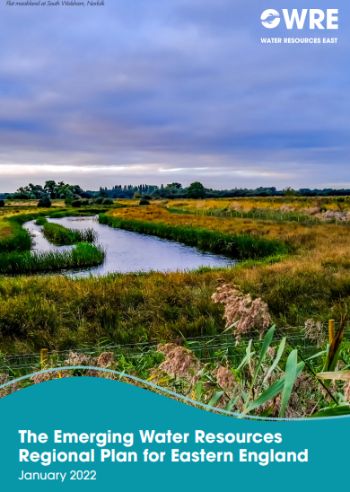
Launching the emerging plan, WRE said the Eastern region of the UK is facing a water crisis - it is short of water now and if nothing changes the water shortage will get worse.
This is the first stage of a two-year process that will culminate in a final plan being produced in autumn 2023. The emerging, adaptive regional plan has been co-created in collaboration with WRE’s cross-sector members and stakeholders. The organisation said the plan sends a clear message that “water is not an issue which can, or should be, solved by one group of water users alone.”
Four key components of the WRE Regional Water Resource Plan focus on:
- Demand management – leakage and Per Capita Consumption (PCC) reduction with multi-sector water efficiency measures
- Large infrastructure options (e.g. reservoirs, transfers, desalination, effluent re-use) >10 Ml/d that have a whole regional, or national significance
- ‘Local’ non-water company and smaller (<10 Ml/d) water company infrastructure projects and schemes which requires the specialist, sub-regional knowledge of WRE members
- Supporting, facilitating or overseeing water innovations and exemplars in Eastern England which push the ‘art of the possible’
Emerging plan reveals Eastern region could require around double (2,267 Ml/d) amount of water currently used by 2050
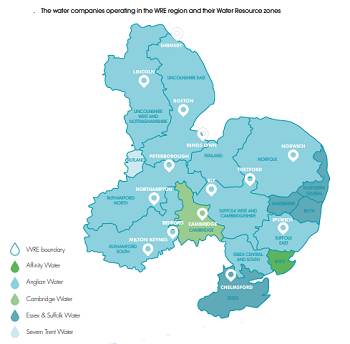
Image source: WRE Emerging Water Resources Regional Plan
The emerging plan reveals that by 2050, the Eastern region could require around double (2,267 Ml/d) the amount of water currently used. This arises from an increasing demand for public water supply and for the agri-food and the energy sectors, alongside an increasing allocation to the natural environment, and mitigating and adapting to the effects of climate change.
By far the biggest driver influencing the plan is the need to leave water in the environment (known as sustainability reductions) to restore, protect and enhance the region’s sensitive water bodies such as the region’s chalk rivers and rewetting landscapes such as wetlands and peatlands that naturally act as a carbon sink, capturing millions of tonnes of CO2.
The new consultation highlights a number of emerging supply side options and alternative sources, together with demand management measures, that will be needed at different time periods to 2050 to help meet ambitious sustainability reductions and increasing water demand forecasts from across sectors.
The strategic, multi-sector options identified in collaboration with WRE members and stakeholders, will continue to be explored through 2022, together with local and catchment level members’ and stakeholders’ demand and supply options, to inform WRE’s draft regional plan published for consultation in autumn 2022.
Options identified in the emerging plan to help meet the long-term demand include:
- Additional investment by WRE water companies to reduce leakage and help customers use more water efficiently
- Development of two new multi-sector reservoirs, aquifer storage and recovery and effluent re-use schemes and next generation desalination using renewable energy
- Identification of local multi-sector options, for example, storage reservoirs and open waterways that can also act as flood resilience while also providing benefits to tourism and well-being
- Exploration and piloting of innovative tariffs
Work on flagship projects to continue in conjunction with emerging plan
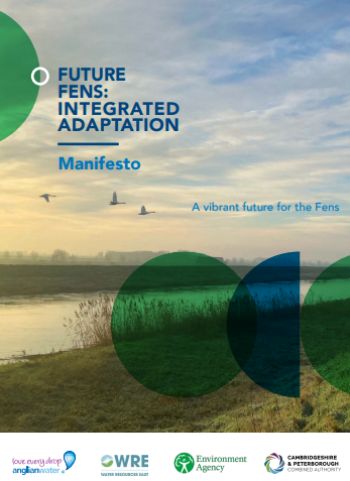
In conjunction with the emerging plan, work on WRE’s flagship projects with members and partners will continue to 2023 and help inform the Final Water Resources Plan published in autumn 2023, including. Some of these projects include:
- Future Fens, an integrated multi-benefit water management strategy in the Fens
- The Norfolk Water Management Plan aiming to create a long-term investable programme of nature based solutions, delivered at scale, that can attract large scale funding to help address water security challenges
- The Chalk Stream Restoration Project which is reviewing approaches to improving the resilience of chalk stream catchments, taking a wider view than simply reducing abstraction
According to Dr Paul Leinster, Independent Chair of WRE, the emerging plan marks a key stage in the national water resource planning process. Launching the consultation, he commented:
“We are consulting on our emerging water resources plan for the East of England. It contains developing thinking on how best to help address the water crisis in the Eastern region and also takes in to account the national situation. The current focus is on identifying the no or low regret actions which are appropriate to progress now. These will include the initial planning and development aspects of strategic options. It will be many years before they are providing additional water supplies, but work needs to start on them now.
“However, the actions will not be taken by WRE. It will be for other sectors to incorporate the issues and solutions identified within their planning processes. The WRE plan and process will provide a context and a means by which interested parties can have more confidence in making their choices.”
With just under two years to go before we publish our ‘final’ Regional Plan, this is a good time to pause and reflect and to invite people to provide feedback on the work to date and the emerging proposals for this first-ever multi-sector water resource management plan for the East of England”.
New MD brings wealth of experience and knowledge from his previous positions

Daniel, Johns, currently Head of Public Affairs for Anglian Water, replaces Dr Robin Price as MD – Dr. Price is re-joining Anglian Water to take up the role of Director of Quality and Environment.
Before joining Anglian Water, Daniel was a senior civil servant at Defra where he worked on water, agriculture, and environment policy. Before that, he spent four years at the Climate Change Committee as their Head of Adaptation. He will be joining WRE on 17 January 2022.
Commenting on Daniel Johns’ appointment, Dr Leinster added:
"We are really pleased to be able to make this announcement. Daniel brings with him a wealth of experience and knowledge from his previous positions. He is joining WRE at an exciting time as we enter the next phase of the regional water resource management planning process and WRE’s growing maturity as an inclusive organisation, bringing together water users across the region to collaborate on addressing the water challenges the region faces.
“Daniel’s appointment will build on the great work and firm foundation Robin, the rest of the team, and our members and stakeholders have provided in getting us to the point of issuing our Emerging Water Resources Regional Plan on 17th January 2022.
“I would like to thank Robin for his leadership and vision in taking WRE from Anglian Water’s initial, cross-sector water resource management concept approach, to establishing WRE as a an independent, not-for profit, multi-sector organisation with more than 200 members and stakeholders”.
Deadline to respond to consultation is 28 February 2022
The strategic, multi-sector options identified in collaboration with WRE members and stakeholders will continue to be explored through 2022, together with local and catchment level members’ and stakeholders’ demand and supply options.
Deadline to submit responses to the consultation, which will be used to develop WRE’s draft regional plan published for consultation in autumn 2022, is 28 February 2022.
WRE will host a consultation webinar on the emerging water resources plan on 1 February 2022. Email This e-mail address is being protected from spambots. You need JavaScript enabled to view it for details
Click here to download WRE Emerging Water Resources Regional Plan for England in full
Click here for more about WRE’s emerging regional plan and to respond to the consultation
 Near-real-time microbial monitoring of wastewater discharge and bathing waters is now possible thanks to the BactoSense ID solution created by Swiss-based bNovate Technologies.
 ABB has launched AquaMaster+™, a digital platform for smart water network management, designed to help water utilities monitor, analyze and manage their water networks, preventing pipeline water losses and optimizing operations.
 Craig Nienaber, Business Development Manager for Safe Access Solutions (SAS) at HUBER Technology, explores why the company is seeing a growing level of interest in its safe access solutions for critical infrastructure providers, including their application in wastewater treatment assets.
 Albion Water, the first NAV (New Appointment & Variation) to have been established in1999 and now under the ownership of SDS Water Group, has appointed Andy Holland as its new Director of Business Development.

 Southern Water has released film and images showing what it’s like to walk inside Hampshire’s expanded Yew Hill underground reservoir for the very last time, before it gets filled with water.
 Hear how Scottish Water has completed its £235 million Ayrshire Glasgow Resilience Project - customers across Greater Glasgow, Ayrshire and East Renfrewshire will now benefit from a more secure and resilient water supply.
 Hear how United Utilities is accelerating its investment to reduce spills from storm overflows across the Northwest.