

With ongoing public & regulatory pressure on water companies to massively improve their operational performance, Adrian Heneghan from HUBER Technology talks about the key roleCombined Sewer Overflows (CSOs) incorporating screens play in mitigating the impacts of sewage discharges into rivers, lakes and seas.

Adrian Heneghan: The sole purpose of CSOs and storm overflows is to act as emergency discharge valves in our sewerage system, discharging wastewater when the system comes close to bursting, supposedly during periods of intense rainfall. Without these waste water can start backing up in our houses and gardens, so they are a vital part of our sewerage infrastructure. However, there is increasing concern that they are being used to regularly dispose of sewage, even during times of low rainfall or none at all.
When CSOs or storm overflows without screens are ‘activated’, sewage litter and waste water is discharged to receiving watercourses. Where screens are fitted they are sized for specific spill volumes to provide protection to the receiving watercourse against aesthetic or ‘gross’ pollution. However, if the design spill volume is exceeded often gross solids such as faeces, toilet paper, wipes and sanitary products will be released into the environment. Currently there are approximately 21,462 CSOs and pumping stations in England and Wales (Source: Environment Agency, 2020).
The Government is now getting tougher, saying the Storm Overflows Discharge Reduction Plan Consultation “will revolutionise how water companies will tackle the number of discharges of often untreated sewage, which the Government and the public have made clear is completely unacceptable."
Under the plan,water companies will face strict limits on when they can use CSOs and storm overflows and must completely eliminate the harm any discharge causes to the environment. Proposals in the aforementioned plan include:
Protecting the environment:
“Water companies shall only be permitted to discharge from a storm overflow where they can demonstrate that there is no local adverse ecological impact. This must be achieved for all storm overflow sites by 2050. Below is a summary of what the water companies (England) have been tasked with.


This means the screen must be designed and maintained so that it always effectively achieves the solid separation and flow rates that it was designed for. This target must also be met by 2050 - This will lead to major improvements to an estimated 660 storm overflows discharging to waters used for recreation and leisure and is expected to reduce discharges from these overflows close to designated bathing waters by over 70% during the bathing season, although they expect significant reductions to occur outside of the bathing season as well.
The Government is clear that water companies must aim in the long-term to completely eliminate all harm from storm overflows. These targets, overall, are expected to lead to an 80% reduction in the overall number of annual discharges from storm overflows by 2050, which is an anticipated overall reduction of over 300,000 storm overflow discharges.
The water companies are now facing significant increases in both the levels of investment and practical measures they will need to put in place to tackle the issues, which if not addressed will lead to ever greater fines, ODI penalties and reputational damage. The Environment Agency is piling on the pressure with a call for prison sentences for company directors in the worst cases and for those directors to be struck off where necessary to deliver a significantly stronger message.
These are major challenges for water companies which they need to address as a matter of urgency, but the reality is they will not be able to do it all immediately. As the saying goes, ‘Rome wasn’t built in a day’, so what can they do in meantime to strengthen the resilience of their existing systems and reduce the risk of the operational failures which lead to pollution incidents?
Supplier point of view – Maintain your equipment and optimise asset health
From a supplier point of view, the key area which immediately springs to mind is ensuring that equipment and infrastructure at all points of the wastewater treatment process are monitored and maintained regularly. Looking at a range of pollution incidents during the last decade, initial equipment failure at a single point in the process which has the potential to cascade and amplify the impacts further downstream has all too frequently been a significant contributory factor.
Screens play a key role in this process, an area where HUBER has developed significant expertise whilst supplying industry leading technologies over years of working with many of the water companies.Based on our experience, maintaining existing equipment in place is fundamental to ensure it is in proper working order and stays that way. Simply put, when the risks are ODI penalties, reputational damage, prosecution by the Environment Agency and eye watering fines, when it comes to asset health, prevention is always better than cure. The risks are only too real. Recent months have seen some significant fines levied on water companies and this situation is likely to get tougher.
It is encouraging to see that included in the Consultation on the Government’s Storm Overflows Discharge Reduction Plan 31 March 2022, there is a clear responsibility for the water companies to ensure screens are maintained in order to provide adequate protection of watercourses from aesthetic pollution. This is where HUBER’s field service engineers can apply their expertise and help end users ensure appropriate maintenance regimes are implemented.
Climate change impacts changing low flow levels to high flow levels
Different sites have different requirements. Some sites only have static screens installed to protect watercourses which are periodically cleaned manually. Following logic, these should be cleaned after every storm event. Cleaning regimes have generally been put in place to prevent waste matter getting to outfalls which feed into receiving watercourses but resourcing and reacting to fast changing conditions is extremely challenging for all water companies.
In our opinion, due to their footprint requirements, traditionally static screens should mainly be installed where there are relativelylow spill flows and frequencies and where the amenity value of the receiving watercourse is none/low, or the cost of installing a permanent power supply is prohibitive. However, with water companies now having to look as far ahead as 2050, the impacts of climate change and more extreme weather events mean low flows are now turning into medium/higher flows. As a result, this increases the risk of a lot more solids being discharged into watercourses, especially if rudimentary screens are installed. In our experience, the risk of failure or malfunction with this type of equipment significantly increases when manual intervention is required to clean them after storm events. Often with limited resources, increased and more extreme spills, this cleaning regime is not likely to be sustainable.
HUBER do not supply static screens, our focus is on powered screens, which operate on three phase power, (single phase where necessary) and deliver a number of operational advantages compared to static and non-powered self cleansing screens.
At sites when the CSO/storm overflow is located in an area where the watercourse has a medium/high amenity we would always recommend installing a powered screen. This includes supplying all the related control and instrumentation equipment to ensure all solids greater than 6 mm in 2 dimensions are captured, which prevents ‘aesthetic’ solids from entering stormwater outfalls from where they enter receiving watercourses. However, water companies have their own guidance/asset standards as to when powered screens should be used versus static and non-powered, self cleansing screens, but we believe the benefits powered screens offer result in lower operating costs and require significantly fewer interventions when CSO’s/storm overflows are monitored correctly.
When selecting the most appropriate HUBER screen, the data we get from water companies or their consultants is of vital importance. The very basic information we require to initiate things is the spill volume. This gives us a starting point (usually a 1:5 year spill flow has to be screened as a minimum). We would also ask for the maximum flow into the chamber, the pass forward flow and any details that may be available pertaining to existing chamber designs. Once we have this most basic information we can provide a preliminary hydraulic profile to allow modellers to calculate the effect of installing a screen to ensure this does not cause issues elsewhere within that sewer network. This is vital in avoiding introducing potential flood risk to properties and infrastructure. Once initial hydraulic checks are made, together with the client/consultant/contractor we can develop the solution further.
It is a similar process where a new build CSO chamber is required, but with our range of weir mounted RoK Screens we can usually provide a solution that results in the smallest chamber footprint and therefore overall the least expensive constructed screening solution for almost every CSOand storm overflow scenario. Our screening solutions have ranged from double digit spill flows to several thousand litres per second involving straightforward screenings return to the continuation flow to sometimes quite complex solutions where dealing with the captured solids at the point of spill provides significant benefit to the network. This is something water companies will need to be cognisant of when addressing such a high number of storm overflows. Simply retaining captured solids within the network will increase the loadings at the end of the line waste water treatment plant inlet works - possibly leading to plant upgrades to provide additional capacity.
When looking to retrofit powered screens it is not always straightforward, but generally we always come up with a solution. Years of work on numerous projects means HUBER has a considerable amount of experience and expertise to draw on and they are used to overcoming challenges. With proven equipment installed over the past 30 years (+1400 units in the UK and Ireland with even more in widespread use globally), it is true to say that all the UK water companies have the highly versatile range of HUBER RoK screens in place. Our suite of RoK screens comprise of 3 different models with standard screens utilised widely, but there are adaptations available to expand the application of this robust yet simple screening solution:

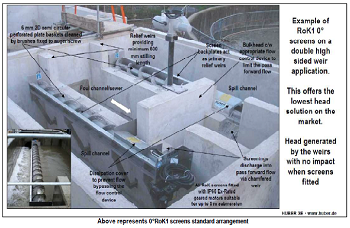

RoK1 60º screen on low sided weir application
Relief weirs can be lower than screen backplate to reduce head in the event of screen/power failure.

CSO failures – water companies increasingly have no place to hide

At an operational level pressure on available manpower and resources can have an impact, but failures of CSOs/storm overflows inevitably have a cascade effect resulting in some of the big problems the water companies are being taken to task on.
At HUBER we are all too aware of what happens in those circumstances, which can often put companies at risk of breaching their environmental permit. We are familiar with the problems and the implications of not addressing these issues swiftly and effectively and in emergencies we can always move to provide a fast response.
Increasingly, with the advent of smart phones and social media there is no place to hide when things go wrong. In one incident we were called out to help when eagle-eyed members of the public spotted rag floating in the river.
Someone swimming in the sea or river or surfing, or simply walking alongside a watercourse can film or take a photograph of what they are seeing and disseminate information about pollution events quickly and widely. In addition, citizen science data is becoming hugely important. For example, the Environment Agency has established a new citizen science portal, while some of the Rivers Trust groups, who are campaigning for bathing water river status in their areas, are also incorporating citizen science into their activities.
Whether we are working directly with the water companies themselves, their Tier 1 partners or external consultants, the ability to work collaboratively and come up with the most suitable, cost and carbon efficient solution is a key part of our skill set. As part of this we host ‘Lunch and Learn’ workshops for individual water companies and their partners. This is a two way process, we get to understand more about their operational processes and challenges, they get to learn more about our technologies and how we can help.
To sum up, we are seeing a growing level of interest and uptake in our CSO/storm overflow screening technologies - no doubt driven in part by the fact that the issue of sewage discharges is now firmly in the forefront of the minds of the Government, regulators and the public alike. It is of course high on the water companies’ agenda and is set to remain there for some considerable time to come.
So, while tackling the challenges associated with the eventual removal of a significant number of CSO’s/storm overflows will involve a considerable amount of time, resources and investment, in the meantime the water companies have a lot to gain from taking advantage of existing technologies and a supply chain which stands ready and able to help.
Visit the website at www.huber.co.uk

 Southern Water has released film and images showing what it’s like to walk inside Hampshire’s expanded Yew Hill underground reservoir for the very last time, before it gets filled with water.
 Hear how Scottish Water has completed its £235 million Ayrshire Glasgow Resilience Project - customers across Greater Glasgow, Ayrshire and East Renfrewshire will now benefit from a more secure and resilient water supply.
 Hear how United Utilities is accelerating its investment to reduce spills from storm overflows across the Northwest.