
Environment Agency warns again on deteriorating water quality and diminishing water resources
 The Environment Agency is reiterating its warnings over deteriorating water quality and diminishing resources in the face of population growth and climate change in its latest reports on the state of water resources, water quality, air quality and soil in England.
Environment Agency & RSBP look for landowners to partner in pioneering flood project
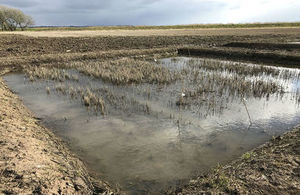 The pioneering Water for Farming and Wildlife (WFFW) project, a partnership between the Environment Agency and RSPB, is exploring whether temporarily flooding agricultural land around the Humber could benefit farmers and wildlife.
Climate change - research study warns of potential 2m+ sea level rise by 2100
 An international research study led by the University of Bristol is warning that if global warming continues at its current rate, the high temperature “business as usual’ scenario could see sea level rise in excess of 2 metres by 2100.
EA Chief warns water industry “needs to up its game” to survive in its present form
 Environment Agency Chief Sir James Bevan is warning that if the water industry wants to survive in its present form and to retain the current economic model “ it needs to up its game” and show that private companies can act in the public interest.
Affinity Water warns of water shortages unless government acts now
 The UK’s largest water only company, Affinity Water is warning that within the next 25 years and beyond, there may not be enough water due to climate change, population growth and increases in demand.
UN: effects of climate change on global investments set to cost trillions of pounds
 An upcoming report from the United Nations on the effect of climate change on global investments is expected to warn that global delays in tackling the issue are set to cost the world's biggest companies nearly £1 trillion, according to Sky News.
Environment Agency - £7m beach nourishment scheme will protect thousands of properties in Lincolnshire
 The Environment Agency’s Lincolnshire Beach Management scheme gets underway on 13 May, helping the Environment Agency manage coastal flood risk to around 20,000 homes and businesses, 24,500 static caravans, 35,000 hectares of land as well as a thriving tourist industry.
Nature on the brink – report warns unprecedented decline in biodiversity puts 1m species at accelerating risk of extinction
 A landmark new report is warning that nature is declining globally at rates unprecedented in human history and the rate of species extinctions is accelerating with 1,000,000 species threatened with extinction.
CCC call for zero carbon UK economy by 2050 welcomed by business, industry and NGOs
The Committee on Climate Change report published today which calls on the Government to deliver zero carbon emissions by 2050 for the UK has been welcomed by a wide range of business, industry and environmental organisations.
CCC tells Government – raise UK game on climate change and aim for zero carbon emissions by 2050
 The Committee on Climate Change (CCC) is calling on the Government to raise its game and set an ambitious new target to reduce the UK’s GHG emissions to zero by 2050.