

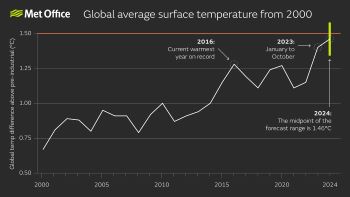
The Met Office is warning that the outlook for global temperature suggests 2024 will be a further record-breaking year, expected to exceed 2023, which is itself almost certain to be the warmest year on record.
The anticipated two-stage spike in global temperature has received a temporary and partial boost by the current El Niño event warming the tropical Pacific.
However, says the Met Office’s Prof Adam Scaife:
“The main driver for record-breaking temperatures is the ongoing human-induced warming since the start of the Industrial Revolution.”
Prof Scaife continued:
“With a month to go, 2023 is almost certain to be the warmest year on record, exceeding the current record set in 2016 which was also boosted by an El Niño event.”
Global average temperatures are measured as the difference between 1850-1900: a proxy for the Industrial Revolution. The global average temperature for 2023 is expected to be below 1.5 °C, but next year’s forecast suggests for the first time that values of 1.5 °C or above cannot be ruled out.
The average global temperature for 2024 is forecast to be between 1.34 °C and 1.58 °C (with a central estimate of 1.46 °C) above the average for the pre-industrial period (1850-1900). This would be the 11th year in succession that temperatures will have reached at least 1.0 °C above pre-industrial levels.
“We expect two new global temperature record-breaking years”
The Met Office’s Dr Nick Dunstone, who led the forecast, said:
“The forecast is in-line with the ongoing global warming trend of 0.2 °C per decade, and is boosted by a significant El Niño event. Hence, we expect two new global temperature record-breaking years in succession, and, for the first time, we are forecasting a reasonable chance of a year temporarily exceeding 1.5 °C.”
Dr Dunstone concluded:
“It’s important to recognise that a temporary exceedance of 1.5 °C won’t mean a breach of the Paris Agreement. But the first year above 1.5 °C would certainly be a milestone in climate history.”
The Paris Agreement is widely accepted to refer to a long-term average of 1.5 °C, rather than an individual year. A Met Office-led paper published in the journal Nature earlier this month suggested a means of immediate recognition when the Paris Agreement guard rail has been reached.
The current year has seen many record-breaking months for global temperature.
The latest 2023 observed WMO estimate (covering January-October) is +1.40 °C and is exceeding the Met Office’s forecast issued at the end of 2022 (1.08 °C to 1.32 °C with a central estimate of 1.20 °C).
Commenting on the forecasts Prof Adam Scaife concluded:
“In addition to the El Niño event, we have anomalous high temperatures in the North Atlantic and Southern Ocean and together with climate change, these factors account for the new global temperature extremes.”
National Audit Office warns UK Government is upderprepared for extreme weather
The warning follows on from the publication of a new report on Wednesday from the National Audit Office on UK resilience which is separately warning that Government is upderprepared for extreme weather
The National Audit Office (NAO) is warning that the government is underprepared for extreme weather events which have the potential to cause significant disruption to the country.
The NAO is calling on the government needs to step up its preparation to limit the impact extreme weather events can have on people, businesses, and communities.
 Near-real-time microbial monitoring of wastewater discharge and bathing waters is now possible thanks to the BactoSense ID solution created by Swiss-based bNovate Technologies.
 ABB has launched AquaMaster+™, a digital platform for smart water network management, designed to help water utilities monitor, analyze and manage their water networks, preventing pipeline water losses and optimizing operations.
 Craig Nienaber, Business Development Manager for Safe Access Solutions (SAS) at HUBER Technology, explores why the company is seeing a growing level of interest in its safe access solutions for critical infrastructure providers, including their application in wastewater treatment assets.
 Albion Water, the first NAV (New Appointment & Variation) to have been established in1999 and now under the ownership of SDS Water Group, has appointed Andy Holland as its new Director of Business Development.

 Southern Water has released film and images showing what it’s like to walk inside Hampshire’s expanded Yew Hill underground reservoir for the very last time, before it gets filled with water.
 Hear how Scottish Water has completed its £235 million Ayrshire Glasgow Resilience Project - customers across Greater Glasgow, Ayrshire and East Renfrewshire will now benefit from a more secure and resilient water supply.
 Hear how United Utilities is accelerating its investment to reduce spills from storm overflows across the Northwest.