

Leading environmental organisation WWF has published a new report setting out an integrated framework for flood management, drawing on policy, green infrastructure and conventional engineering to help communities adapt and better manage growing flood risk.
Introducing the report "Natural and Nature-Based Flood Management: A Green Guide", the NGO said that worldwide, flood risk will continue to rise as cities grow larger and rainstorms become more intense, making conventional engineering insufficient as the sole approach to flood management.
"We can't afford to continue to invest in short term solutions that don't take into account how weather patterns, sea levels and land use are changing the nature and severity of flooding," said Anita van Breda, World Wildlife Fund's senior director of environment and disaster. "The traditional approaches we've used to manage flooding in the past – like sea walls and levees – in most cases, won't work in isolation for the types of floods we're likely to experience in the future."
The Flood Green Guide, developed in partnership with the U.S. Agency for International Development Office of U.S. Foreign Disaster Assistance (USAID/OFDA), provides a step-by-step framework for flood managers to understand the factors contributing to flood risk in their region, and to pull together the appropriate policies, nature based solutions, and traditional engineering to address the problem.
 Globally, flooding is the most common disaster risk, accounting for nearly half of all weather-related disasters during the past 20 years. Exposure and vulnerability to flood risks are on the rise: the proportion of the world population living in flood-prone river basins has increased about 114 percent and population exposed to coastal areas has grown 192 percent during the last decade.
Flooding in Sri Lanka over the weekend triggered by monsoon rains has seen almost 500,000 people displaced from their homes, at least 126 people killed and scores are still missing.
"New roads, tunnels and bridges should not only be able to withstand more severe flooding, but ideally contribute to the community's resilience and safety," van Breda continued. "Our framework encourages engineers, flood managers, planners, community members, and policymakers to collaborate around the table from the start to work together addressing multiple objectives."
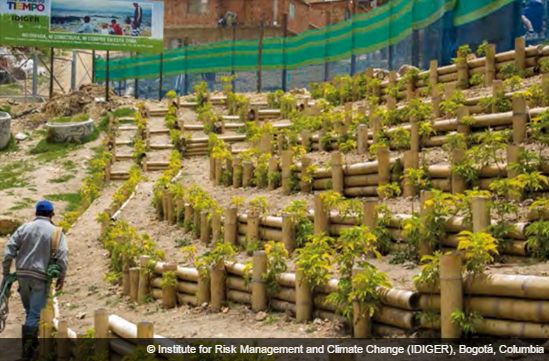
The guide promotes using non-structural methods such as land use zoning as first step, and then integration of natural and nature-based methods, combined with hard engineering if needed, to manage flood risk.
Natural and nature-based methods, like upstream reforestation, green roofs on downstream urban areas and wetland restorations and management can improve the function of - and reduce overall costs associated with - conventional engineering. They also allow communities to reap the co-benefits the environment can provide such as: cleaner water, reduced air temperatures and green space for human recreation while protecting livelihoods such as agriculture and fishing.
Sezin Tokar, Senior Hydrometeorological Hazard Advisor for USAID/OFDA commented:
"Floods do not recognize national or administrative boundaries. Any action in one part of the watershed will affect everyone else living in the watershed. That's why an integrated and basin-wide approach is critical to save lives and protect the property of people living near the water."
According to WWF, the most durable flood management strategies are locally specific and factor in what's happening in the watershed, both upstream and downstream of individual projects.
The guide will be supported by a training curriculum (currently under development), specifically designed for those responsible for flood risk management, including municipal governments, community groups and non-governmental organizations worldwide.
Click here to access the Natural and Nature-Based Flood Management: A Green Guide
 Enpure Ltd and Clean TeQ Water Ltd have announced a collaboration agreement to bring Clean TeQ Water's Moving Bed Ion Exchange-based nutrient removal technologies to water utilities across the UK.
 Near-real-time microbial monitoring of wastewater discharge and bathing waters is now possible thanks to the BactoSense ID solution created by Swiss-based bNovate Technologies.
 ABB has launched AquaMaster+™, a digital platform for smart water network management, designed to help water utilities monitor, analyze and manage their water networks, preventing pipeline water losses and optimizing operations.
 Craig Nienaber, Business Development Manager for Safe Access Solutions (SAS) at HUBER Technology, explores why the company is seeing a growing level of interest in its safe access solutions for critical infrastructure providers, including their application in wastewater treatment assets.

 Southern Water has released film and images showing what it’s like to walk inside Hampshire’s expanded Yew Hill underground reservoir for the very last time, before it gets filled with water.
 Hear how Scottish Water has completed its £235 million Ayrshire Glasgow Resilience Project - customers across Greater Glasgow, Ayrshire and East Renfrewshire will now benefit from a more secure and resilient water supply.
 Hear how United Utilities is accelerating its investment to reduce spills from storm overflows across the Northwest.