

With parts of Paris under water and France facing its wettest January in more than a century, a major new report from the OECD is warning that further improvements are needed to manage major flood risk in Paris and the Seine basin.
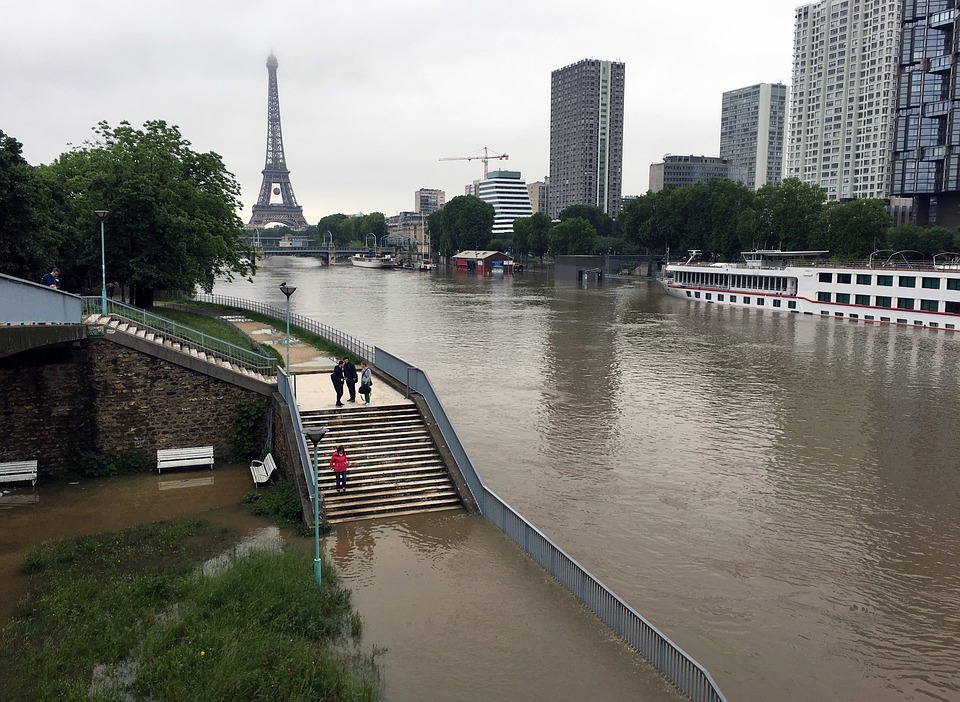 Action to prevent the risk of major flooding in Paris and the Ile de France region has improved in recent years – particularly after the Seine burst its banks in May and June 2016. However, urban and territorial planning needs to be better adapted, governance strengthened and long-term funding clarified, according to the OECD, which says that the risk of the Seine flooding in the Ile de France region is a major one.
The progress report - Preventing the Flooding of the Seine 2018 which was presented this week, also questions whether the flood prevention funding structure is sufficiently ambitious and assured over the long-term.
Commissioned by the Direction Régional and the Établissment Public Territorial de Bassin Seine Grands Lacs, the report said the authorities had made progress in 10 of the 14 recommendations from the OECD’s 2014 Review Seine Basin, Île-de-France, Resilience to Major Floods. Most progress had been made in understanding the vulnerabilities and reinforcing a culture of risk prevention.
However, the OECD says that although important efforts have been made to improve the governance of risk prevention, a fragmented institutional structure is undermining a commitment to specific, long-term objectives.
The flooding of the Seine in May and June 2016 caused more than €1 billion-worth of damage and severe disruption to a number of transport networks. Two people died in the flooding while 17,500 were evacuated from their homes. A repeat of the scale of the historically high flooding in Paris in 1910 could affect up to 5 million people today and cause up to €30 billion worth of damage, the OECD estimated in 2014.
The OECD says current infrastructure development schemes, urban renewal plans associated with the Grand Paris project and the city’s hosting the Olympic Games in 2024 all provide opportunities to reinforce and make permanent the resilience of the French capital and its region to the risk of serious flooding while also providing an innovative model of adapting to climate change.
"Need to develop a more ambitious and long-term funding strategy”
 But the report says that despite the mobilisation of additional financial resources, the current flood prevention funding strategy is “not commensurate with the economic stakes involved.” All the existing risk prevention funding mechanisms are now mobilised (Barnier fund, CPER, FEDER, water agency and local authorities).
“However, the amounts involved, the themes covered, and uncertainty over the sustainability of some funding sources clearly point to a need to develop a more ambitious and long-term funding strategy.”
The OECD said this could include raising the flood prevention tax for financing protective infrastructures in place in France (Gestion des millieux aquatiques et prevention des inondations, GEMAPI) and creating complementary incentive mechanisms. According to the report the flood tax put in place by the Grand Paris Metropolitan Authority could represent a significant source of funding to finance new structural protection and storage measures or to strengthen existing infrastructure.
“However, this possibility cannot be the only prospect of long-term funding and the role of the State in the face of this nationwide risk remains highly important.” the OECD says.
Click here to download Preventing the Flooding of the Seine 2018
Click here to read the OECD report online Seine Basin, Île-de-France, 2014: Resilience to Major Floods
 Albion Water, the first NAV (New Appointment & Variation) to have been established in1999 and now under the ownership of SDS Water Group, has appointed Andy Holland as its new Director of Business Development.
 UK water companies are invited to join an upcoming webinar which will explore how the sector can take indirect potable reuse (IPR) from concept to full-scale operational reality.
 James Sumsion, CEO of predictive water intelligence specialists Kohtari, says the water sector needs to take a giant leap forward, so that it can anticipate and act upon water quality issues - rather than merely react.
 Ray Moulds, Sales Director at Flood Control International, takes a look at how automated sliding floodgates are supporting secondary containment at water and sewerage company sites.

 Hear how Scottish Water has completed its £235 million Ayrshire Glasgow Resilience Project - customers across Greater Glasgow, Ayrshire and East Renfrewshire will now benefit from a more secure and resilient water supply.
 Hear how United Utilities is accelerating its investment to reduce spills from storm overflows across the Northwest.
 Find out more about the remarkable career opportunities on offer at WSP - scroll down to watch the inspirational video.