

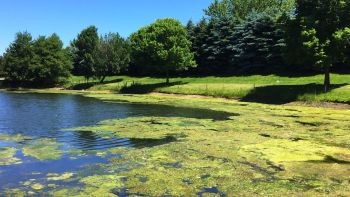
Department of Agriculture, Environment and Rural Affairs (DAERA) Minister Andrew Muir has announced 20 actions his Department will take to improve water quality, address the challenges in Lough Neagh and tackle blue green algae (BGA).

The Minister made the announcement in the Assembly on 2nd July, highlighting that many of the DAERA actions were already underway and those remaining will be taken forward by his Department as soon as possible.
Situated in the centre of Northern Ireland, Lough Neagh is the largest freshwater lake in the UK covering an area of 383 km2 with a longest length of 30.5 km and narrowest width of 12.1 km across the middle. The lake is very shallow for its size with an average depth of 8.9 metres. At its deepest point it extends down to 34 metres.
The 20 DAERA actions form part of the wider Lough Neagh Report and Action Plan which is currently under consideration by the Executive. The 20 measures are DAERA-only actions and do not require Executive approval.
Minister Muir said:
“Lough Neagh is of huge importance to people here. It is our most important natural resource, supplies 40% of our drinking water and its significance to those who depend on the Lough for business and recreational purposes cannot be overstated.
“Whilst the wider Lough Neagh Report and Action Plan remains under consideration by the Executive colleagues I have a responsibility to ensure that the actions that my Department can take are taken and taken at pace. The time for action is now.
“I will continue to engage with Executive colleagues to secure agreement on the remaining issues within the report, but the situation is such that it is important to take the necessary action that we can now.
“We know that the policies and programmes we have advanced in the past have contributed to creating the impacts we are now witnessing. We also know that excess nutrients in the environment cause pollution in our waterways and we also know the main contributing sources are agriculture and, to a lesser but still significant extent, wastewater, from both treatment works and septic tanks.
“I am committed to improve water quality, address the challenges in Lough Neagh and tackle blue green algae and have already allocated £7.5million towards this, however, further investment will be needed not only in the short but in the longer term. Inadequate funding will have a detrimental impact on implementing the interventions needed.”
The actions, and those remaining within the Lough Neagh Action plan, are grouped into four key pillars:
- Education: empowering knowledge and skills and encouraging best practice;
- Incentivisation: investment and innovation aimed at motivating, and funding actions which will drive the adoption of behavioural change;
- Regulation: our statutory obligation to protect the quality of our water; and
- Enforcement: taking strong, meaningful action when compliance with regulation fails.
The Minister concluded:
“The issues surrounding the Lough and the wider water environment are complex and very challenging. Addressing these issues will require changes in our behaviours and practices and I am determined to build and sustain a culture of environmental responsibility fostering an attitude of zero tolerance to pollution.”
The 20 actions relevant to DAERA include:
- Deliver Water Quality monitoring outreach events to farm businesses in the Lough Neagh catchment to build on the information provided by soil analysis and runoff risk mapping within the Soil Nutrient Health Scheme (SNHS). To optimise nutrient application on the farm.
- Provision of training in compliance and environmental performance to slurry spreading contractors. To reduce risk of runoff to watercourses.
- Scope and implement a suite of water quality-based initiatives including farm sustainability training and advisory campaigns, ensuring that these incorporate actions to promote experiential learning.
- Commence a Small Business Research Initiative to investigate feasible and affordable solutions to reduce Blue Green Algal blooms when they occur.
- Scope the expansion of the Sustainable Catchment Programme (SCP) into more Lough Neagh catchment areas. Reducing point and diffuse nutrient losses from agricultural sources.
- Continue Lough Neagh Environmental Farming Scheme Group Project. To ensure an Environmental Management Plan for each participating farm.
- Complete the statutory review of the Nutrients Action Programme (NAP), consult on proposals within the updated NAP and introduce revised NAP Regulations. Reduce the nutrient losses to water from agricultural sources.
- Engage and fully consult with stakeholders regarding a new regulatory framework for the processing of slurry to reduce land spreading of excess phosphorus, resulting in renewable energy production and recycling/reuse of organic nutrients. Reduce phosphorus loading to land.
- Increased activity focused in areas of highest risk including cumulative breaches and informed by scientific evidence with a view to having a focussed enforcement taskforce. Improving water quality.
- Establish an enforcement project team to explore and fully consult on enforcement methods including fixed penalty notices for non-compliance. Deterrent to reduce pollution incidents.
 Craig Nienaber, Business Development Manager for Safe Access Solutions (SAS) at HUBER Technology, explores why the company is seeing a growing level of interest in its safe access solutions for critical infrastructure providers, including their application in wastewater treatment assets.
 Albion Water, the first NAV (New Appointment & Variation) to have been established in1999 and now under the ownership of SDS Water Group, has appointed Andy Holland as its new Director of Business Development.
 UK water companies are invited to join an upcoming webinar which will explore how the sector can take indirect potable reuse (IPR) from concept to full-scale operational reality.
 James Sumsion, CEO of predictive water intelligence specialists Kohtari, says the water sector needs to take a giant leap forward, so that it can anticipate and act upon water quality issues - rather than merely react.

 Hear how Scottish Water has completed its £235 million Ayrshire Glasgow Resilience Project - customers across Greater Glasgow, Ayrshire and East Renfrewshire will now benefit from a more secure and resilient water supply.
 Hear how United Utilities is accelerating its investment to reduce spills from storm overflows across the Northwest.
 Find out more about the remarkable career opportunities on offer at WSP - scroll down to watch the inspirational video.