

A giant stainless-steel vortex system has been lowered into the shaft at Hammersmith Pumping Station as part of the supersewer for London which is currently under construction.
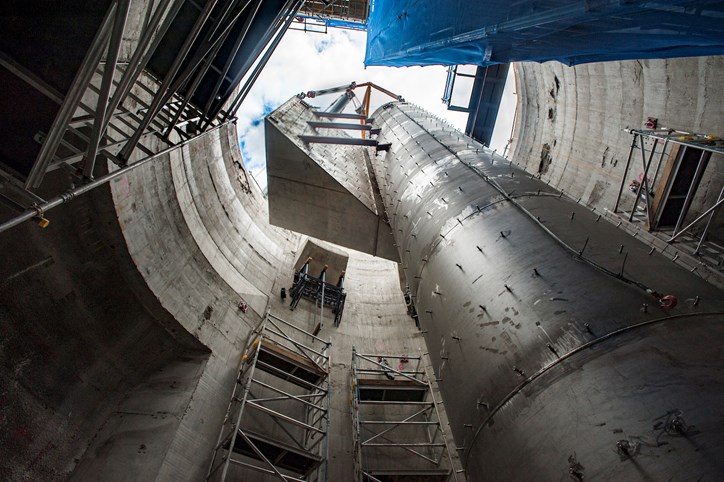
The system forms the centrepiece of the work taking place at the site as part of the Tideway Tunnel project.
Around two million tonnes of sewage overflows from the pumping station and into the River Thames every single year.
Tideway, the company responsible for delivering the £4.2 billion project, is working to divert those flows into a new 25km super sewer, currently under construction deep beneath the river.
However, at Hammersmith the flows need to drop down a 15-metre-deep shaft – which is why the vortex is needed.
Falling that distance, the flows would wear away the bottom of the shaft; but the 28-tonne vortex generator will ‘spin’ the flows down the pipe, removing the energy and preserving the base.
This week, the vortex was rotated and dropped down into the shaft in a complex and meticulously-planned lifting operation.
The 21-metre-long, 65-tonne pipe section of the system has had over 1,000 stainless steel studs painstakingly welded onto its outer wall that slotted precisely into place during the installation.
 Near-real-time microbial monitoring of wastewater discharge and bathing waters is now possible thanks to the BactoSense ID solution created by Swiss-based bNovate Technologies.
 ABB has launched AquaMaster+™, a digital platform for smart water network management, designed to help water utilities monitor, analyze and manage their water networks, preventing pipeline water losses and optimizing operations.
 Craig Nienaber, Business Development Manager for Safe Access Solutions (SAS) at HUBER Technology, explores why the company is seeing a growing level of interest in its safe access solutions for critical infrastructure providers, including their application in wastewater treatment assets.
 Albion Water, the first NAV (New Appointment & Variation) to have been established in1999 and now under the ownership of SDS Water Group, has appointed Andy Holland as its new Director of Business Development.

 Southern Water has released film and images showing what it’s like to walk inside Hampshire’s expanded Yew Hill underground reservoir for the very last time, before it gets filled with water.
 Hear how Scottish Water has completed its £235 million Ayrshire Glasgow Resilience Project - customers across Greater Glasgow, Ayrshire and East Renfrewshire will now benefit from a more secure and resilient water supply.
 Hear how United Utilities is accelerating its investment to reduce spills from storm overflows across the Northwest.