

A combination of careful cleaning, cold weather and very careful herbicide treatment has stopped the spread of Ludwigia, also known as creeping water primrose, at the WWT London Wetland Centre in Barnes, south west London. Invasive species are considered a major threat to biodiversity by the International Union for Conservation of Nature (IUCN).
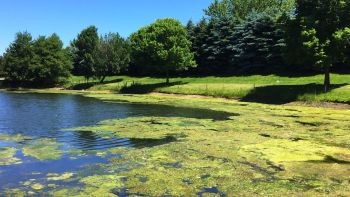
Ludwigia was first identified at the site when it was being developed from the Barn Elms Reservoirs in 1998. The plant had spread to around 25m2 by the time of the centre's official opening in 2000. If left unchecked it would have rapidly taken over the wetlands and waterways across the site, impacting on wildlife by out-competing native plant species and reducing the diversity of plants and habitats available in the wetland.
London Wetland Centre’s ongoing efforts using annual staff and volunteer hand-pulling groups restricted the plant’s spread but did not eradicate it altogether.
Biocide plays key role in eradication programme
Folowing partnership work between the Environment Agency and WWT the plant has disappeared after careful treatment by hand-wiping a herbicide directly onto the plant’s stem in 2008 and 2009. The harsh winter of 2010 probably helped to eradicate the species altogether, a rare success when it comes to tackling this type of invasive species.
The Environment Agency provided advice about the best methods of getting rid of the plant and gave the WWT Topfilm, a sticking agent which improves the herbicide’s effectiveness by causing it to stick to the target plant and preventing it from affecting other plants.
Roundup Biactive, the glyphosate-based herbicide that was used, is one of the safest herbicides approved for use on or near water in the UK. Because the WWT London Wetland Centre is a Site of Special Scientific Interest (SSSI), all pesticides or herbicides it uses are approved by Natural England.
Joanna Heisse, an Environment Agency conservation officer, said:
“Everyone who has been involved in this battle is absolutely thrilled that together we’ve finally been able to eliminate Ludwigia from the WWT London Wetland Centre. This has been helped as the WWT London Wetland Centre is a well managed site.
“Looks can be deceiving. Although this plant seems pretty it can have a detrimental effect on wildlife and other plant species, and causes immense problems in France, Belgium and Holland. We are keen to avoid similar problems happening in the UK.
“This is a great example of two organisations working in partnership to achieve a positive outcome for the environment, a great success for the 2010 International Year of Biodiversity.”
Careful monitoring is now needed to ensure it does not re-appear on site, together with awareness raising of how to spot it and the risk it poses to wildlife.
There are 14 other known sites with Ludwigia present in the UK, with the Barnes example being one of two in London. The other is at the Kidbrooke Green Nature Reserve in Greenwich.
Ludwigis could cost UK £150-million-plus a year
Ludwigia originates from South America and is often sold under several names, including primrose willow, Ludwigia grandiflora and Ludwigia peploides. The plant grows in the margins of slow flowing waters, ponds, canals and lakes where it can rapidly form mats of creeping stems which grow into taller plants bearing large, distinctive, five petalled yellow flowers.
It is a huge problem in France, Holland and Belgium. One 500ha lake in South west France was entirely covered in under six years, which equates to a growth rate of 83ha a year. Although its establishment and spread is limited in the UK, similar growth rates could be likely, particularly with climate change. An economic study has estimated that Ludwigia could cost the UK over £150 million per annum if it were allowed to establish.
Other problems caused by Ludwigia include increasing flood risk by spreading across areas of open water, clogging waterways and creating an obstruction to flows on rivers or canals. Recreational activities such as angling and navigation can also be affected and people or animals could mistake mats of Ludwigia for solid ground.
Richard Bullock, a biodiversity officer at the WWT London Wetland Centre, said:
"WWT working successfully in partnership with the Environment Agency to eradicate Ludwigia from the London Wetland Centre demonstrates best practice as part of a UK strategy.
“The ultimate aim is to ensure that Ludwigia should no longer pose a threat to our native wildlife. Indeed, successful control programmes such as this illustrate there is potential for this invasive species to become as rare as its unpretentious native cousin – the Hampshire Purslane.
“Furthermore, it provides real hope for conservation managers across the UK that this troublesome plant could someday soon be removed from the precious wetlands of Britain altogether.”
 Albion Water, the first NAV (New Appointment & Variation) to have been established in1999 and now under the ownership of SDS Water Group, has appointed Andy Holland as its new Director of Business Development.
 UK water companies are invited to join an upcoming webinar which will explore how the sector can take indirect potable reuse (IPR) from concept to full-scale operational reality.
 James Sumsion, CEO of predictive water intelligence specialists Kohtari, says the water sector needs to take a giant leap forward, so that it can anticipate and act upon water quality issues - rather than merely react.
 Ray Moulds, Sales Director at Flood Control International, takes a look at how automated sliding floodgates are supporting secondary containment at water and sewerage company sites.

 Hear how Scottish Water has completed its £235 million Ayrshire Glasgow Resilience Project - customers across Greater Glasgow, Ayrshire and East Renfrewshire will now benefit from a more secure and resilient water supply.
 Hear how United Utilities is accelerating its investment to reduce spills from storm overflows across the Northwest.
 Find out more about the remarkable career opportunities on offer at WSP - scroll down to watch the inspirational video.