

Engineering & Operations Director Dave Thompson draws on 30 years of experience at HUBER Technology UK to look at challenges facing the UK water sector.

Photo: Dave Thompson, centre, celebrates 30 year career with HUBER Technology UK
Dave Thompson: I joined the water industry in 1990, shortly after privatisation, initially working for HUBER’s UK agent. I was one of a group of eight who joined HUBER’s newly established UK subsidiary in 1994 and in January 2024 I celebrated 30 years of working for HUBER. During that time HUBER Technology has grown to an eighty-strong company with multiple sites across the UK which is part of a global group of HUBER companies employing 1500 people worldwide.
In 1990 HUBER had a toe-hold in terms of market share in the UK water sector - but we also had a growing reputation for supplying small inlet screens – principally our Ro9s and sludge screens.
Since then HUBER has successfully continued to evolve over the years to help the water companies tackle the many challenges they have to address – an ongoing process which builds on decades of knowledge and experience. Our product range, our production capacity and our in-house expertise have all expanded significantly.
I believe we led the way as the first supplier in the industry to routinely manufacture all our equipment in stainless steel – other manufacturers followed our example and this has now become commonplace.
From our starting point in the UK as a supplier of small screens, we now occupy a significant position in the sector as the supplier of some of the very largest screens in use in the UK today.
Some of the largest treatment works in the UK (and globally) now use HUBER inlet screens and screenings handling equipment. To take just one example, one of our first large inlet works projects was in 2013 at Belfast sewage treatment works which helped establish our reputation as a supplier of large screens with the HUBER RakeMax® and EscaMax®.

Photo: aerial view NI Water's Belfast Sewage Treatment Works
One of our strengths lies in looking ahead and keeping up to speed with industry developments and emerging issues both in the UK and overseas. Legislative drivers in Europe and the UK to protect our rivers and coastal waters – like the Bathing Water Directive, Shellfish Directive and Water Framework Directive have stimulated the development within HUBER of a broad range of products for tertiary screening (HUBER RoDisc®) and filtration (HUBER RotaFilt®).
Likewise, action on climate change provided the impetus to develop the ThermWin processes for wastewater heat recovery - we now have 65 ThermWin installations worldwide at reference sites in Europe and North America. And we’re quietly confident that we will have similar projects in place in the UK in the not too distant future.
But just as we were motivated to develop new products and processes we’re also seeing a high level of interest in one of our best-established products as a result of the massive and ongoing pressure on the water companies to tackle the thorny issue of stormwater discharges from Combined Sewer Overflows (CSOs).

Image: Combined Sewer Overflows located in Marine Protected Areas
In December new Environment Secretary Steve Barclay wrote to water company Chief Executives telling them to go “further and faster” to secure a measurable reduction in sewage spills in 2024.
HUBER CSO screens at Blackburn Meadows STW screen spill flows of up to 30,000 litres of water per second
Since the mid 1990s HUBER has supplied over 1,400 of our Rok1 and Rok2 CSO screens in the UK – and we’ve also helped to develop the standards for how these screens are used. One of the stand-out projects for me is our delivery of the UK’s biggest CSO projects in the UK at Yorkshire Water’s Blackburn Meadows sewage treatment works in 2011/12 where we installed CSO screens capable of screening spill flows of up to 30,000 litres per second. Our work on that scheme capitalised on and brought to bear all the knowledge, experience and lessons learnt on previous projects.

Photo: HUBER screens at Yorkshire Water's Blackburn Meadow sewage treatment works
It’s clear that there are still many unsatisfactory CSOs which need to be addressed and we are certainly seeing an increase in demand for our CSO screens, together with a growing level of interest in HUBER’s micro screening technology as a subsequent treatment step for stormwater.
Sludge treatment a key focus for both water sector and HUBER
Further pressure for the water companies in the form of challenges for the disposal to land of sludge, together with the increased production of sludge in AMP8 as a result of the WINEP programme, means that sludge treatment has now become a key focus for both the water industry and HUBER.

Photo: HUBER S DISC installation at Anglian Water Newton Marsh,Tetney Wastewater Treatment Works
With the increase in sludge production and restrictions on disposal that have taken place over the last 25 years, we have gone from no presence in the marketplace to our present-day position as a major supplier of sludge thickening, dewatering and drying equipment.
We’ve developed packaged thickening solutions, based around our HUBER S-DISC thickener to meet the demand for small scale sludge thickening plants with a specific focus on reducing transportation costs to sludge treatment centres. For those sludge treatment centres we have developed medium temperature sludge drying technology, with 89 dryers installed globally.
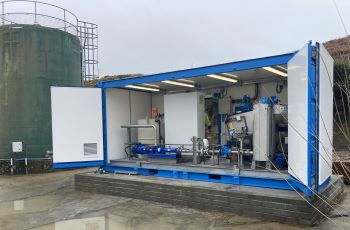
Photo: HUBER S-DISC Skid mounted in a container
Tapping into knowledge networks and expertise across a global business
Over the course of 30-odd years, we now have 50,000 equipment installations worldwide and the applications experience that goes with it. So how do we go about capitalising on all that knowledge and expertise in a globally dispersed business?
What would have been hugely challenging 30 years ago, today the widespread use of digital solutions, including the use of conference call technology which became routine during the Covid epidemic, has not only enabled remote working within the UK, it’s also made it much easier and faster to create knowledge networks which run across HUBER’s global business.
In addition, access to training no longer depends on face to face meetings for that knowledge and skills transfer. So while face-to-face might still be the gold standard, HUBER now routinely deliver product training over Teams to a widely dispersed worldwide employee base. However, to truly embed organisational and operational knowledge means not only providing those people with the right training and putting access to information at their fingertips, it also requires a level of experience and skillset which can only be accumulated over time.
I’m very fortunate in that I’m able to draw on a wealth of experience - of my own from my long career with HUBER, and that of an Engineering Manager and a Projects Manager who likewise have many years of experience with the company. Between us there’s a lot of shared knowledge and mutual understanding which we try to impart to our newer members of staff.

Photo: HUBER HQ and production facilities in Berching, Germany
Nonetheless, in a large company with a diverse product range everybody can’t know everything. At HUBER it’s equally important that we signpost where knowledge resides within the organisation so employees in different parts of the business don’t spend time grappling with problems which have already been tackled and solved elsewhere.
This ability to identify where they can get the information and resources they need to do their job effectively extends right across HUBER’s businesses worldwide.
To take just one example, colleagues based in the United States were working on a project in Seattle involving CSO screens, an area where they had limited experience. They were able to quickly see on the HUBER intranet that here in the UK we had extensive experience with our installed base of 1400 CSO screens. An initial telephone call quickly identified that the Seattle project was very similar to one we’d already worked on in Northern Ireland.
A subsequent Teams call with their consultant in Southern California, our colleague in our Northern Ireland service depot, followed by a call with NI Water to validate what worked delivered clear benefits in terms of time and money to our American colleagues and their client alike.
Transformational impacts of digitalisation

However, in my experience established knowledge, processes and procedures will only get you so far and it’s clear that the way in which we work are constantly evolving and developing through digitalisation. For instance, we now have the ability to use 3-D printing to produce prototype plastic components. We can use this technology for trialling products and confirm they are what we need, before we progress to the next stage of injection moulding to produce thousands of them.
One of the most significant changes during the course of my career has undoubtedly been the way in which digitalisation has facilitated much richer human interaction. In my view, while of course companies have their embedded processes and procedures in place, organisations create new knowledge by the sharing and blending of knowledge, insight and experience.
This also extends beyond our own organisation to how we work with our clients and customers – and the relationships we establish with them at a personal level have a key role to play in this. People only share their knowledge with people they trust - and achieving that level of mutual trust, understanding and knowledge makes all the difference to delivering the best outcomes.
We see this on live projects time and again – by combining established organisational knowledge with new ideas, thinking and experiences that often come from younger engineers can in turn create new knowledge and added customer value.
We actively encourage people who aren’t necessarily constrained by conventional approaches to express their views, challenge established thinking and explore ways in which they might have done things differently.
At HUBER, we believe that lessons learnt are invaluable going forward – far more learning can come out of that process than simply sharing your successes. Knowledge is one of the most important intangible assets an organisation has – yet its importance is often overlooked in many companies.
Skills gap - potentially a major challenge for water companies and supply chain in AMP8

Of course, the commitment to this is of one of the biggest challenges facing HUBER in the UK and the wider water sector – the ongoing skills shortage. Finding people with the right skills is a major issue. As a company we are proactive and going some way to address this via apprentice programs, together with the recruitment and development of trainees.
However, in my view it really requires a government-led approach to tackle the problem. I’m sure other companies, including the water companies, are facing the same issues. If it’s affecting the water industry, it is undoubtedly affecting other sectors - and if it’s happening to us, it’s likewise affecting our competitors and our peers.
Looking to AMP8 and the considerable challenges the wider water sector needs to tackle, this is potentially one of the single most important barriers that both the supply chain and the water companies need to mitigate in order to deliver the biggest-ever investment programme since privatisation.
To sum up, protecting the environment from pollution and doing so in an energy-efficient way has been one of the principal legislation drivers in our industry. I’d like to conclude by saying that on a personal level, it has also been the key driver for sustaining my interest during my long and varied – and never boring – career with HUBER. And when I see a HUBER machine which is still in operation after 30 years, I think we have delivered something which has really worked for our customer. It’s still working, it’s still doing its job, it’s delivered real value for money and it’s protecting the environment – what more could you ask for?
So whilst it’s essential that we are an efficient and profitable business, I’m keen to ensure that HUBER UK leaves a positive legacy of sustainable solutions that will endure far longer than the memories of our financial results.
If we’ve gone some way to achieving that, then that will be a lasting legacy for everyone at HUBER that we can all be proud of.
Email: This e-mail address is being protected from spambots. You need JavaScript enabled to view it

 Hear how Scottish Water has completed its £235 million Ayrshire Glasgow Resilience Project - customers across Greater Glasgow, Ayrshire and East Renfrewshire will now benefit from a more secure and resilient water supply.
 Hear how United Utilities is accelerating its investment to reduce spills from storm overflows across the Northwest.
 Find out more about the remarkable career opportunities on offer at WSP - scroll down to watch the inspirational video.