

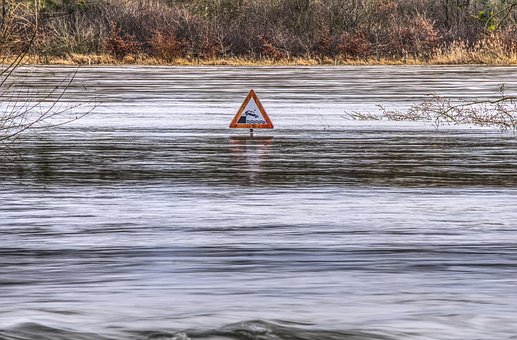
A new report from the Environment Agency (EA) is recommending that the best way to provide maps of flood extents and impacts in real time to support improved flood incident management is through a combination of pre-made flood maps and simplified flood modelling.
The report has been published as part of the Flood and Coastal Erosion Risk Management R and D Programme jointly overseen by Defra, the Environment Agency, Natural Resources Wales and the Welsh Government on behalf of all Risk Management Authorities in England and Wales.
The Real-time flood impacts mapping - Technical report covers a research project undertaken to understand the options available for real-time mapping of flood impacts and how, when and where this information could help support the flood incident response.
Main findings from the report include:
- The main user needs are for maps of flooding and its impacts, with time-varying information as an event develops.
- Simulation libraries currently have the most potential to meet the user requirements. In this approach, flood extents, depths and impacts information are selected during an event from a library of pre-computed results.
- Real-time simplified fluvial modelling, in which models are run ‘on demand’ during an event, also has significant potential. These models would be of greatest benefit in situations too complex to represent using pre-computed scenarios.
- Both options could be implemented relatively efficiently on a national scale by reusing existing models and data held by the Environment Agency
The focus of the project was on flooding from rivers, although surface water and groundwater were also considered.
The project examined how maps could be linked to flood forecasts generated by the EA’s National Flood Forecasting System (NFFS) which supports flood incident management by forecasting river flow and level at specific locations.
The Agency asked users from a broad range of backgrounds, including emergency planners and responders representing all risk management authorities about:
- what information they would need to manage a flood incident
- what works and what does not
- what they felt was missing
Two groups were approached to help understand the problem from their different points of view:
- information generators such as Environment Agency flood incident rooms
- information consumers such as Gold and Silver Command centres
The Agency said all consultees wanted maps showing forecast flood extents and flood impacts rather than lines on a graph, and also considered time-varying and regularly updated inundation and impact information important.
Both groups agreed that any real-time mapping solution must pass 2 fundamental tests:
- It must work in the early hours of the morning, when users are under pressure and possibly tired.
- It must produce information that can be understood by non-technical decision-makers within 10 seconds.
An expert panel identified 14 feasible options, shortlisting six for further investigation based on their fit with user requirements, cost and overall potential.
Detailed analysis of the options involved comprehensive proof of concept experiments which were designed to answer three key questions:
- Is the option technically feasible?
- What information does it provide?
- How well does it perform?
The most promising proof of concept tests were:
Simulation libraries. These currently have the most potential to meet the user requirements. In this approach, flood extents, depths and impacts information are selected during an event from a library of pre-computed, detailed flood model results
Real-time simplified fluvial modelling. This involves running reduced accuracy, but quick-to-run flood models ‘on-demand’ during an event.
Findings from the research have subsequently been used to help steer and influence major Environment Agency initiatives such as improvement to flood forecasting projects and the New National Flood Risk Assessment.
Click here to download the full report Real-time flood impacts mapping
 Albion Water, the first NAV (New Appointment & Variation) to have been established in1999 and now under the ownership of SDS Water Group, has appointed Andy Holland as its new Director of Business Development.
 UK water companies are invited to join an upcoming webinar which will explore how the sector can take indirect potable reuse (IPR) from concept to full-scale operational reality.
 James Sumsion, CEO of predictive water intelligence specialists Kohtari, says the water sector needs to take a giant leap forward, so that it can anticipate and act upon water quality issues - rather than merely react.
 Ray Moulds, Sales Director at Flood Control International, takes a look at how automated sliding floodgates are supporting secondary containment at water and sewerage company sites.

 Hear how Scottish Water has completed its £235 million Ayrshire Glasgow Resilience Project - customers across Greater Glasgow, Ayrshire and East Renfrewshire will now benefit from a more secure and resilient water supply.
 Hear how United Utilities is accelerating its investment to reduce spills from storm overflows across the Northwest.
 Find out more about the remarkable career opportunities on offer at WSP - scroll down to watch the inspirational video.