

The National Audit Office is warning that 200,000 properties are at increased flood risk due toEnvironment Agency defence assets being below required condition - and the EA has cut its forecast for the number of additional properties that will be better protected from flooding by 40% since plans were first unveiled in 2020.

A new report by the NAO - Resilience to flooding - sets out that EA has reduced its forecast of the number of properties it will be able to better protect by 2027 from 336,000 to 200,000, a reduction of 40 per cent. In addition, EA is removing 500 of the 2,000 new flood defence projects that were originally included in the programme. This is despite government doubling its capital funding in England in the six years to 2027 to £5.2 billion to combat the danger of flooding.
EA estimates that, in 2022-23, approximately 5.7 million properties in England were at risk from flooding. This figure has increased by around 500,000 between 2021-22 and 2022-23. EA reports that this is due to a better understanding of the level of risk, through improved information, rather than an increase in risk. There is also risk to transport and utilities infrastructure from flooding.
In the first two years of the government’s six-year flood and coastal erosion management programme, EA has improved protection from floods for 59,000 properties in England against a commitment when the programme was announced of better protecting 336,000 by 2027.
EA assessed that maintaining 98% of its high consequence assets at their required condition at a cost of £235 million would provide the best value for money. EA maintains some 96,000 flood defence assets.
However, a shortfall of £34 million in its annual resource funding for 2022-23 meant that EA would only be able to maintain 94%-95% of its assets at the required condition resulting in 203,000 properties at increased risk of flooding. Although this is not a directly comparable figure, it exceeds the 200,000 properties that are forecast to be better protected through the capital programme. EA estimates that inflation accounts for between a half and two-thirds of this reduction.
Private sector businesses - often major beneficiaries of capital programme but contribute little towards its cost
Most of the individual projects within the capital programme are required to secure additional funding, known as partnership funding, from other sources including local authorities and local businesses. The EA estimates that a total of £2.3 billion of partnership funding is needed for the capital programme but continuing inflationary pressures are likely to see this rise further. This is an increase on the £1.5 billion of partnership funding that was estimated at the start of the capital programme. In July 2023, around £800 million out of the £2.3 billion required partnership funding was yet to be secured, of which £450 million is for projects that will contribute to the government’s 2027 target.
The report says that private sector businesses are often major beneficiaries of the capital programme but contribute little towards the cost of the programme: to date across the capital programme only 9% (£128 million) comes directly from private sector contributions.
EA needs average spend of c£1 billion each year over remaining 4 years of the programme
As a result of the slow start to the programme, there was an underspend of £310 million in the first two years of the capital programme. HM Treasury (HMT) has deferred the funding for use in later years to ensure that Defra is funded to meet the government’s commitment to spend £5.2 billion on flood defences. According to the NAO, as a result of this and with investment already at record levels, EA will need to spend an average of almost £1 billion each year over the remaining four years of the programme.
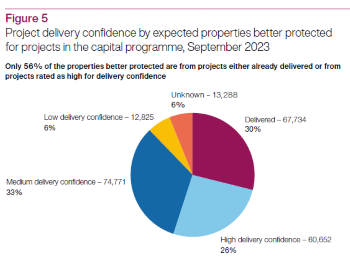
Image NAO: Project delivery confidence by expected properties better protected for projects in the capital programme, September 2023
The NAO report concludes that, although a review of the capital programme is on-going, there is a risk that attempts to meet short-term targets will further erode value for money if projects are accelerated or new ones introduced too quickly as previous experience suggests this can lead to delays and cost overruns.
Failing to meet maintenance targets - more than 200,000 properties at increased risk due to EA assets being below required condition
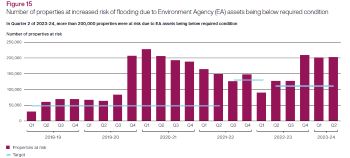
Image NAO: number of properties at increased risk of flooding due to EA assets being below required condition
The report also warns that the EA’s maintenance of its assets is not optimising value for money and the EA is failing to meet its maintenance targets. The Agency assessed that it needed £235 million but agreed £201 million for maintenance following the 2021 Spending Review.
The report warns that for the lack of £34 million in annual maintenance funding for 2022-23, more than 200,000 properties are at increased risk of flooding due to EA assets being below required condition. At the same time, EA underspent by £310 million in the first two years of the capital programme.
However, the NAO says that neither Defra nor EA assessed whether using part of the capital underspend to meet the shortfall in its maintenance budget in 2022-23 would provide better value for money than deferring it to later in the capital programme.
The NAO recommends that Defra, the EA, and HMT should work together to ensure that decisions on the current capital programme are not influenced by short-term funding periods and targets and are focused on maximising value for money and that decisions can be taken quickly to switch money from the capital programme (which funds new projects) into the maintenance budget where this provides value for money.
Difficult for government to make rational and informed decisions about priorities, measure progress or plan long-term effective investment
The report concludes that, although the government wants to achieve greater resilience to flooding in the long term it has no measure for resilience and no target for the level of flood resilience it expects to achieve.
According to the NAO, the government’s vision for flood resilience stretches to the year 2100 and EA has several strategic objectives for 2050.
However, while the EA has set out short-term actions in its roadmap to 2026 it has not mapped out any concrete plans beyond 2026 to bridge the gap between its shorter-term actions and long-term objectives. The report warns that the short-term objectives are not sufficient to achieve its long-term objectives to 2050, and it has not yet established any plans or milestones to bridge the gap.
This will make it difficult for the government to make rational and informed decisions about its priorities, measure its progress or plan effective investment for the long-term, according to the NAO.
Commenting on the report, Gareth Davies, the head of the NAO said:
“Government recognises the growing dangers from flooding and has committed to doubling its capital funding in England in the six years to 2027, as well as doing more to understand flood risk.
“However, the capital funding is forecast to better protect only 60% of properties that were promised when the programme was launched in 2020, while inflation and other programme risks mean the Environment Agency could deliver even fewer than that. If there are further delays to the capital programme, Defra must work with HM Treasury to make sure it is in a position to switch money quickly into maintenance, where this would provide value for money.
"EA will have to manage a record level of capital investment in flood defences for the remaining four years of the programme. In doing so, it must resist pressure to accelerate projects or initiate new ones too quickly, if this is likely to lead to cost overruns and delays and put value for money at risk.”
Report reflects many of same concerns National Infrstructre Commission set out in National Infrastructure Assessment

Commenting in response to the report, Professor Jim Hall of the National Infrastructure Commission said:
“Following the recent disruption in the wake of Storm Ciaràn this report is a welcome reminder of the need to improve efforts to boost flood resilience, and it reflects many of the same concerns the Commission set out in last month’s National Infrastructure Assessment.
“Government must set clear and measurable targets to reduce the likelihood of property flooding in urban and rural areas in line with Commission recommendations, to help quantify and target necessary investment – the NAO report highlights the challenges created by this lack of clarity. It is also concerning to hear it warn of a downgrade in the number of homes that will be better protected under the current floods budget.
“The current focus on short term funding settlements will also do little to bolster efforts to properly maintain flood defences over the longer term and ensure they remain fit for purpose in the face of an evolving climate threat. The need for the Environment Agency to have greater certainty over its long term funding is clear.”
In the Second National Infrastructure Assessment, the Commission said government should invest in enhanced flood risk management infrastructure to reduce the risk of coastal, river and surface water flooding, through setting clear risk reduction targets.
Click here to download the full report Resilience to flooding
 Near-real-time microbial monitoring of wastewater discharge and bathing waters is now possible thanks to the BactoSense ID solution created by Swiss-based bNovate Technologies.
 ABB has launched AquaMaster+™, a digital platform for smart water network management, designed to help water utilities monitor, analyze and manage their water networks, preventing pipeline water losses and optimizing operations.
 Craig Nienaber, Business Development Manager for Safe Access Solutions (SAS) at HUBER Technology, explores why the company is seeing a growing level of interest in its safe access solutions for critical infrastructure providers, including their application in wastewater treatment assets.
 Albion Water, the first NAV (New Appointment & Variation) to have been established in1999 and now under the ownership of SDS Water Group, has appointed Andy Holland as its new Director of Business Development.

 Southern Water has released film and images showing what it’s like to walk inside Hampshire’s expanded Yew Hill underground reservoir for the very last time, before it gets filled with water.
 Hear how Scottish Water has completed its £235 million Ayrshire Glasgow Resilience Project - customers across Greater Glasgow, Ayrshire and East Renfrewshire will now benefit from a more secure and resilient water supply.
 Hear how United Utilities is accelerating its investment to reduce spills from storm overflows across the Northwest.