

With Ofwat shortly due to publish the provisional findings from its Bioresources Market Review, Mike Willis, Business Development Director at HUBER Technology, discusses whether collecting and releasing more data holds the key to further unlocking the full potential of the bioresources market.

Mike Willis - Ofwat’s consultation on proposals to require the water companies to publish more data as a means of supporting further market development for bioresources trading closed two weeks ago.
The outcome of the consultation will no doubt inform Ofwat’s forthcoming provisional findings from its Bioresources Market Review launched in October last year. The regulator is planning to consult separately on the findings from the Review in May 2021.
Throughout the review, Ofwat has identified availability of data as a key tool to enable greater market trading – not simply for the water and wastewater companies themselves, but also for potential and existing participants.
The $64k question – does the data enable potential market participants to identify new business opportunities?

Ofwat has concluded that greater availability and increased transparency of data is key to making the bioresources market function more effectively and deliver more business opportunities.
The regulator has already required the 11 water and wastewater companies active in the bioresources market to publish a wide range of information on their bioresources activities.
However, for the supply chain, the 64,000 dollar question is whether the existing data and the proposals to collect additional data meets Ofwat’s objectives of:
- providing standardised and defined information to enable potential market participants to identify opportunities to supply services in the treatment, transport, recycling and disposal of bioresources;
- ensuring that information is comparable and reliable for use by market participants; and
- enabling Ofwat to monitor the bioresources markets to see how effectively they develop.
Not an easy question to answer – the $64,000 dollar question usually refers to an important issue whose outcome can’t be foreseen which a lot hinges on.
As an equipment supplier, we have spent some time looking at the information being made available to identify the new business opportunities where we can sell our equipment and services. While the water companies are now publishing significant levels of data, this is generally not currently accompanied by any form of interpretation as to the strategy which would help the supply chain to quickly establish where those opportunities lie.
Data without interpretation is of limited value
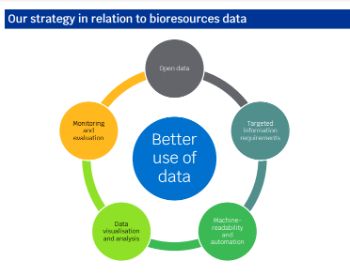
Photo: Source Ofwat
For both existing and potential equipment suppliers and market entrants alike, it’s not always easy to extract from a mass of data and turn it into the necessary intelligence to conclude there is a potential business opportunity.
As it stands, without the addition of further interpretation, for most suppliers translating the data into useful intelligence they can use to inform their business development activities is not a practical option.
I would suggest that a key element which could usefully be added and would undoubtedly help the supply chain would be a mechanism which tied the data in to each individual company’s bioresources strategy.
HUBER are technology specialists in the bioresources market with expertise in both the UK and overseas market. From a personal point of view, having spent some considerable amount of time looking at the data, in its present format without an additional layer of interpretation and observation from the companies themselves it is unfortunately currently of limited value.
Regulatory and structural barriers are acting as a significant drag
Following on from a recent Ofwat stakeholder meeting I participated in to explore the issues in more detail, I would also suggest that there are broader concerns which are significantly hampering the further development of the bioresources market, namely:
- Regulatory and structural barriers
- Limitations of the five year AMP investment cycle
Some of these issues have already been flagged up in the work undertaken by Jacobs as part of Ofwat’s Bioresources Review to identify constraining factors.
Regulatory barriers include the current limitations on the co-digestion of sludge with other bio-waste from other waste treatment processors – which is also an issue for the Environment Agency.
According to Jacobs, the Agency is currently still in the process of modernising, clarifying and addressing regulatory inconsistency with regard to its sludge strategy. The EA is aiming to submit a request for legislative change in mid-2023 to simplify what it describes as “the current complex regulatory framework.”
The structural barriers are possibly even more deep seated and the source of ongoing uncertainty – for example, how assets are accounted for in the water companies’ financial models.
Teasing out the different strands is undoubtedly a challenge of significant complexity. And while it is not a direct issue for the supply chain, we understand that it has significant implications for our water company clients. Again, Jacobs has flagged up issues surrounding the cost of capital and inconsistency in accounting for shared assets and overheads.
Although we have an interest we cannot usefully contribute these structural hurdles – other than to express concerns that they may be slowing up water companies’ bioresources activities.
Potential limitations of five year AMP investment cycle
Finally, we do have concerns about the extent to which the five year AMP investment cycle is limiting the water companies’ scope for further business development. At the risk of over-simplification, business development planning does not take place in discrete, time limited investment periods. It is a dynamic process which needs to be both flexible and adaptable.
The investment the water companies may need to plan for business expansion may well need to be spread over more than one investment cycle. So they may need to build future capacity in one AMP which may not be fully realised until the next one.
As an equipment supplier, we have been ramping up our own business plans and making our own additional investment in anticipation of an uptick of demand for our equipment and services.
However, as current uncertainty continues and until any clearly articulated strategy is formulated which highlights where we can look for the new business opportunities Ofwat wants to see, we are now having to scale back on our own ambitions.
It is a frustrating position to be in – in the bioresources supply chain HUBER Technology sits as sludge treatment technology specialists. As such we are in a strong position to flag up greater efficiencies and the potential for reduced treatment and transport costs that could enable greater options for alternative treatment solutions providers.
Like a number of companies, we are only one part of the bioresources supply chain but the technologies we provide play a crucial role in the operational processes available to treat sludge - in our case, dewatering and thickening.
Data from technology trials demonstrates operational and financial benefits
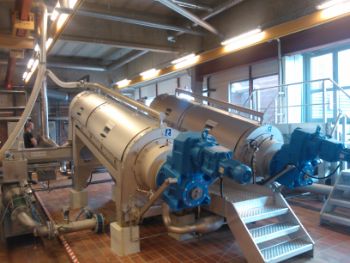
Just to provide a concrete example of the significant differences we can make, our work at Plymouth Central Sewage Treatment Works for South West Water, where the company wanted a more reliable and less labour intensive option to sludge de-watering than a centrifuge, is a case in point.
South West Water had been looking at alternative dewatering technologies with lower TOTEX to potentially replace existing veteran centrifuge assets. The requirements were for lowest Whole Life Costs, low operator attendance and simple operation.
Working with their Tier 1 contractor Kier who were tasked with developing solutions for the Plymouth Central and Maer Lane WwTWs, we ran trials to demonstrate the benefits our Q-PRESS® sludge dewaterering technology could deliver.
Kier undertook the process evaluation which compared whole life costs, operational requirements and product support.
The results spoke for themselves, demonstrating that although the centrifuge M&E only capital cost was lowest, the scheme cost and operating costs of the Q-PRESS® were by far the lowest. Benefits to SW Water included:
- 40% polymer saving
- 80% power savings (typical)
- 50% saving on annual operating costs
- lowest 20 year Net Present Value - NPV is used in capital budgeting and investment planning to analyze the profitability of a projected investment or project.

The HUBER solution delivered results in a short timescale of just three months. The trial data not only satisfied South West Water that it was what they needed but provided hard data to confirm whole life costs in terms of power and chemical consumption – the Q-PRESS® delivered a remarkable £298,208 saving on annual operating costs for one single site alone.
Just to highlight the potential energy, carbon and cost savings on offer to the bioresources sector, extrapolate that out to multiple sites across the rest of the company’s asset base, then in turn to all of the water and wastewater companies’ sites. You’re looking at significant multi-million pound cost benefits alone, quite apart from the potential contributions to the water sector’s net zero carbon target by 2030.
As a technology provider, what would we like to see in the shape of new data or information?
As a technology supplier what would be useful to us is:
- An explanation of the strategy and tactics behind the data
- Where expenditure on bioresources sits with the water companies’ budgets - (Bioresources or Wastewater) for sludge treatment – even in the context of TOTEX, capex and opex are undoubtedly still relevant.
- From a supplier point of view, it would be interesting to know to the extent to which water companies’ decisions are still made at a certain level between opex and capex.
For example, if the capex decision is somewhat cheaper than another alternative capex solution, will that dictate what's brought, irrespective of the fact that they can save more than double in operational terms over a long time period?
I would be interested to know if, in the case at Plymouth described earlier, whether the Q-PRESS® would have been used if the Total Scheme Capital cost had not been lower? Despite the £300k annual saving and substantially lower WLC and NPV. And how much is the payback still constrained within the five year AMP period?
Views of wider supply chain – still an as yet untapped resource
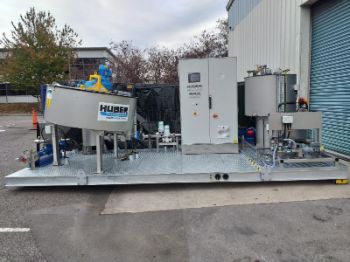
As suppliers, we all realise we can’t have always information which is bespoke to us. We realise that the companies have different operational requirements – but some benchmarking data would be useful to help us understand their sludge strategies.
The situation is further complicated when the procurement of equipment of goods or services comes via a Tier 1 framework partner, rather than directly from the water company.
For example, we know that some of the same pieces of our equipment can be used at sites which vary significantly in terms of both size and complexity. Our S-DISC is being used on sites ranging from 5000 PE (i.e. small) up to 150,000 PE. However, gaining insight into the rationale behind these applications isn’t necessarily a straightforward process.
A collaborative approach to sharing more data can undoubtedly help to deliver the type of outcomes Ofwat is looking to achieve – and the more that Ofwat can do to put the necessary building blocks in place the better.
Supply chain awaits findings from Ofwat Bioresources Review with interest
To sum up, we agree with Ofwat's view that bioresources are a resource and as such their value should be maximised and, probably like other suppliers, we are currently in a holding pattern while we wait to see the outcome of the Bioresources Review and the practical measures that might be put in place to stimulate the market.
We’re hopeful that as more of the companies can see the clear benefit they could derive from our technology, we will see even greater uptake. And if Ofwat want to stimulate further growth in the bioresources marketplace, the opportunity for more active involvement would be welcomed by the wider supply chain, perhaps via British Water – the supply chain trade body.
Watching from the sidelines, we know it has potential to develop further - but real change is needed which goes well beyond suggesting that the water companies publish more data.
There is a danger that failure to remove the structural and regulatory barriers which currently stand in the way of market growth, and the addition of meaningful interpretation and intelligence, will ultimately mean that data is being published for data’s sake.
For further information contact Mike Willis at email This e-mail address is being protected from spambots. You need JavaScript enabled to view it or phone on +44 7887 897322
This in the second in a series of articles from technology specialists HUBER in the run-up to publication of the outcome of Ofwat’s Bioresources Market Review in 2021
 Near-real-time microbial monitoring of wastewater discharge and bathing waters is now possible thanks to the BactoSense ID solution created by Swiss-based bNovate Technologies.
 ABB has launched AquaMaster+™, a digital platform for smart water network management, designed to help water utilities monitor, analyze and manage their water networks, preventing pipeline water losses and optimizing operations.
 Craig Nienaber, Business Development Manager for Safe Access Solutions (SAS) at HUBER Technology, explores why the company is seeing a growing level of interest in its safe access solutions for critical infrastructure providers, including their application in wastewater treatment assets.
 Albion Water, the first NAV (New Appointment & Variation) to have been established in1999 and now under the ownership of SDS Water Group, has appointed Andy Holland as its new Director of Business Development.

 Southern Water has released film and images showing what it’s like to walk inside Hampshire’s expanded Yew Hill underground reservoir for the very last time, before it gets filled with water.
 Hear how Scottish Water has completed its £235 million Ayrshire Glasgow Resilience Project - customers across Greater Glasgow, Ayrshire and East Renfrewshire will now benefit from a more secure and resilient water supply.
 Hear how United Utilities is accelerating its investment to reduce spills from storm overflows across the Northwest.