


Ofwat has published a new report setting out the economic growth case for investment in water supply infrastructure generally- and specifically looks at the contribution of the Major Projects Programme Ofwat is supporting.
According to the report, the United Kingdom faces the growing challenge of water scarcity resulting from climate change, population growth, ageing infrastructure and historical underinvestment in largescale projects to bolster supply.
Without adequate water resources, the potential for population and economic growth, urban development and resilience to environmental shocks becomes constrained, directly curbing a nation’s capacity for expansion and innovation, the report warns.
The report identifies four key economic roles for water that drive economic growth and provides order of magnitude estimates for the potential value of economic growth that could be unlocked in the long term.
Water supply and economic growth
Describing a reliable water supply as “non-negotiable for societal wellbeing and economic prosperity”, the report identfiies the following four key economic roles of water in driving economic growth:
- Growing the labour supply by meeting household demand
- Increasing national resilience
- Unlocking potential in emerging sectors
- Supporting growth in existing industries
Economic benefits of the RAPID Programme

The report also examines the economic benefits of the RAPID Programme (Regulator’s Alliance for Progressing Infrastructure Development) established in 2019 to stimulate a programme of water supply infrastructure investments of an unprecedented scale to improve the sustainability of water supply and support economic growth.
The circa £50 billion major projects pipeline is a significant investment in future economic growth through securing the UK’s future water supply. The report sets out the direct impact of the investment in major capital projects and how investing in the water supply drives economic growth.
“Understanding these links and the scale of impacts are important in avoiding future underinvestment in water supply infrastructure,” the report.
The growth duty on regulators which was extended by the government in 2024 to include Ofwat, Ofgem and Ofcom states that regulators must “give appropriate consideration to the potential impact of their activities and their decisions on economic growth” both for the regulated industry and for the wider economy. The duty highlights infrastructure and investment as a specific driver of economic growth.
Order of magnitude estimates for potential value of long term economic growth
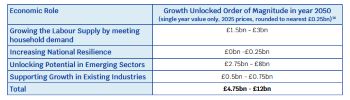
The report also provides order of magnitude estimates for the potential value of economic growth that could be unlocked in the long term.
The Major Projects Programme confirmed a significant increase in water sector investment to address resilience, supply, and environmental challenges. According to the report, large-scale construction programmes of this nature create a temporary one-off boost to economic output and employment, both locally and nationally, during peak construction years. While these effects are temporary, they leave residual, lasting benefits by upskilling and strengthening the UK’s capacity to deliver future infrastructure projects.
The temporary one-off increases in output associated with the major projects programme have been estimated using ONS multipliers for job and Gross Value Added (GVA) impacts. GVA analysis provides an assessment of the economic contribution of individual sectors to domestic outputs and reflects how changes in one sector’s output would affect the economy (through supply chain multipliers, job creation and consumption).
The total temporary oneoff GVA impact identified in the report is estimated at a range of £28 billion to £41.1 billion. In addition, the projects leave behind a more skilled and resilient workforce through boosting labour demand, stimulating training, and encouraging localised skills development. In turn, this workforce
forms a flexible foundation for future infrastructure programmes. Transferable resources and skills such as construction, project management skills and expertise acquired through this programme will be transferred onto future projects (possibly outside of the water industry) and help support the productivity of the construction sector.
Investing now to secure future water supply creates environment to drive long term economic growth
The report concludes that investing now to secure future water supply, alongside other planned investments in demand management, will create the environment to drive long term economic growth and that the Major Projects Programme supported by Ofwat is a major step forward towards achieving this.
In developing the report Ofwat was supported by KPMG, who undertook research and developed the economic analysis presented in the report and the technical annex. The report was finalised in October 2025.
Click here to download the report in full
Click here to download The Economic Impact of Water Supply Infrastructure Investment- Technical Annex provides the methodology and supporting analysis that sit behind the key findings of the report.
 Barhale has completed work on two separate Rapid Action Taskforce Spills projects it is carrying out for Severn Trent.
 Börger UK, which has firmly established itself as a leading pump brand since it was set up in Staffordshire in 2004, has moved into bigger, brand-new premises in Shrewsbury.
 HUBER Technology UK & Ireland are inviting people to register for their March webinar where they will be providing information about HUBER water intake screens for municipal and industrial applications.
 Sulzer has launched a new global Center of Excellence (CoE) for Water Treatment Solutions - the CoE consolidates Sulzer’s wastewater treatment expertise in a unified and global manner.

 Hear how Scottish Water has completed its £235 million Ayrshire Glasgow Resilience Project - customers across Greater Glasgow, Ayrshire and East Renfrewshire will now benefit from a more secure and resilient water supply.
 Hear how United Utilities is accelerating its investment to reduce spills from storm overflows across the Northwest.
 Find out more about the remarkable career opportunities on offer at WSP - scroll down to watch the inspirational video.