

Experts will use satellites to monitor the quality of water in Scotland’s lochs as part of a pioneering new project led by the University of Stirling.
The Faculty of Natural Sciences is working with the Scottish Environment Protection Agency (SEPA) to investigate the feasibility of introducing earth observation technology to its day-to-day operations in a bid to improve the quality and efficiency of water sampling.
Image: European Space Agency
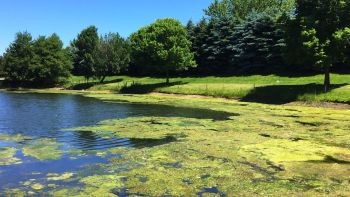
 The cutting-edge approach uses the European Space Agency’s Sentinel-2 satellite to identify potential contaminants in bodies of water, such as algal concentrations, harmful algal blooms, and mineral and organic matter.
Stirling currently leads the £2.9 million GloboLakes project, funded by the Natural Environment Research Council (NERC), which has established the world’s first satellite-based global lake surveillance system.
The new feasibility study will allow scientists to understand how the technology may benefit end users, in this case SEPA, in developing the approach as an operational capability and, in turn, improving their approach to assessing lake water quality.
Dr Claire Neil, a Research Fellow in Biological and Environmental Sciences, is leading the project with SEPA, funded through a NERC Knowledge Exchange Fellowship.
She said: “This is the first step in implementing satellite remote sensing as a regulatory data resource and will produce a step change in the way we monitor quality in the UK.”
Dr Neil will use reflectance measurements, taken from the satellite, to estimate concentrations of chlorophyll-a, in Scottish lochs. The data will then help to assess risk to water quality status and allow SEPA to better target and enhance their sampling efforts.
“Recent scientific achievement through projects such as NERC GloboLakes have provided the scientific know-how which allows us to characterise a large range of optical water types with satisfactory accuracy,” Dr Neil explained.
“This method of monitoring provides a more detailed and representative view of the whole lake, when compared to current sampling techniques that typically assess water quality in samples taken close to the lake edge.
“As such, measurements obtained from satellite remote sensing will increase our confidence in assigned water quality status and will provide an opportunity to direct sampling efforts.”
The £70,000 year-long study will begin this month - further funding may allow the project to be extended by another two years.
 Albion Water, the first NAV (New Appointment & Variation) to have been established in1999 and now under the ownership of SDS Water Group, has appointed Andy Holland as its new Director of Business Development.
 UK water companies are invited to join an upcoming webinar which will explore how the sector can take indirect potable reuse (IPR) from concept to full-scale operational reality.
 James Sumsion, CEO of predictive water intelligence specialists Kohtari, says the water sector needs to take a giant leap forward, so that it can anticipate and act upon water quality issues - rather than merely react.
 Ray Moulds, Sales Director at Flood Control International, takes a look at how automated sliding floodgates are supporting secondary containment at water and sewerage company sites.

 Hear how Scottish Water has completed its £235 million Ayrshire Glasgow Resilience Project - customers across Greater Glasgow, Ayrshire and East Renfrewshire will now benefit from a more secure and resilient water supply.
 Hear how United Utilities is accelerating its investment to reduce spills from storm overflows across the Northwest.
 Find out more about the remarkable career opportunities on offer at WSP - scroll down to watch the inspirational video.