

A smarter water industry could upgrade creaking pipelines to an optimised, efficient, adaptable network. Beyond this, while still in its infancy, the water industry is also showing great promise regarding the adoption of Artificial Intelligence (AI).
 In the first article of a two part Expert Focus series for Waterbriefing about smart and intelligent water solutions, Andrew Welsh General Manager – ICA Department at Xylem UK & Ireland, explores the options.
 Andrew Welsh: The UK’s water and wastewater infrastructures are in desperate need of an upgrade. With Michael Gove only recently challenging the water industry to halve leakage by 2050, we must not rest on our laurels.
Thousands of miles of ageing infrastructure play host to a growing number of concerns, from leaks and burst mains, to collapsed sewers and blockages.
Operational efficiency remains the main driving force for the UK water and wastewater industries, but this year’s scorching summer has also highlighted that we can no longer take a secure supply for granted.
As a water manager, you’ll have a number of issues that you need to address: How can you improve operational efficiency and performance without replacing miles of existing pipework? How can you ensure a consistent supply of clean water to the consumer? How can you protect the surrounding environment, while demonstrating compliance with all Ofwat targets? Finally, how can you do all of this without running up a bill so eye-wateringly huge that you soon find yourself looking for a different line of work?
These solutions exist in the form of smart technologies: software and hardware that collect, monitor and analyse data in real-time to provide unprecedented insight into the performance of a water network. They switch operational strategies from those based on reacting to demand, to those that predict it.
A three step approach
The UK’s water and wastewater industry has long suffered from a history of under-investment. For this reason, making the move to smart, data-powered infrastructure will not be an easy one. Up-front costs may deter some companies, as will a lack of in-house digital skill. Fortunately, gradual implementation is not only feasible: it’s highly advisable.
Consider the implementation of intelligent equipment as a first step. In manufacturing circles, this often takes the form of sensors or monitors that gather data on the performance of a piece of machinery, based on configured expectations. Water and wastewater are no different. Intelligent solutions exist to track a number of key performance indicators, such as leaks, corrosion, breaks or degradation.
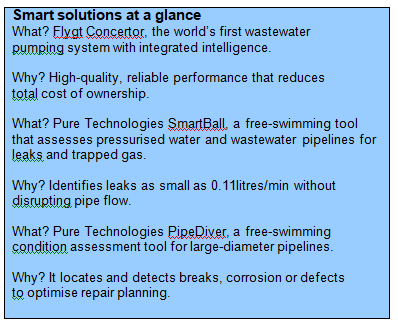 Once the data are collected, move on to analysing and actioning it. Digital solutions, such as software or analytical programmes, help water managers to make sense of the data collected by collating, analysing, ordering and displaying them. This facilitates any future decisions by water managers, who will now benefit from concrete data, rather than more spurious performance indicators like the equipment’s age or any recorded failures.
Once you have implemented a system of intelligent equipment and digital solutions in your most critical areas, you can begin to branch out across your infrastructure, thus creating a smart network of data exchange for forecasting, optimising, diagnosis and visualisation.
Thames Water has installed such a network, using comprehensive, accurate, daily data readings to address water loss and identify supply issues. The results speak for themselves: more accurate, equitable billing for customers, prompt identification of leaks and pipe ruptures, and a 13 per cent reduction in water consumption.
While these developments are exciting in theory, we know change will not happen overnight. However, by taking a gradual approach to smart water implementation while appreciating the benefits of AI as an evolution rather than revolution, you too could stand to reap long-lasting rewards.
In the next article, Andrew Welsh will take a look at the future potential of AI once barriers to adoption are broken down.
 Near-real-time microbial monitoring of wastewater discharge and bathing waters is now possible thanks to the BactoSense ID solution created by Swiss-based bNovate Technologies.
 ABB has launched AquaMaster+™, a digital platform for smart water network management, designed to help water utilities monitor, analyze and manage their water networks, preventing pipeline water losses and optimizing operations.
 Craig Nienaber, Business Development Manager for Safe Access Solutions (SAS) at HUBER Technology, explores why the company is seeing a growing level of interest in its safe access solutions for critical infrastructure providers, including their application in wastewater treatment assets.
 Albion Water, the first NAV (New Appointment & Variation) to have been established in1999 and now under the ownership of SDS Water Group, has appointed Andy Holland as its new Director of Business Development.

 Southern Water has released film and images showing what it’s like to walk inside Hampshire’s expanded Yew Hill underground reservoir for the very last time, before it gets filled with water.
 Hear how Scottish Water has completed its £235 million Ayrshire Glasgow Resilience Project - customers across Greater Glasgow, Ayrshire and East Renfrewshire will now benefit from a more secure and resilient water supply.
 Hear how United Utilities is accelerating its investment to reduce spills from storm overflows across the Northwest.