

Watercycle Technologies Ltd, a UK deep tech company focused on developing sustainable, high-yield, low-cost, mineral extraction and water treatment systems, has for the first time, successfully produced lithium carbonate from naturally occurring geothermal brines in the North East of England.

This represents a major step forward in the UK’s ambitions to produce a domestic supply of lithium to power the domestic energy transition and the UK Government’s goals of achieving net zero. Lithium is a critical raw material utilised in the production of electric vehicle batteries.
The University of Manchester spin-off, which is backed by business accelerator Aer Ventures, is focused on developing high-yield, low-cost mineral extraction, and water treatment systems. Its advanced innovative membrane distillation-crystallisation (MDC) technology is capable of treating highly concentrated water and is initially being utilised in lithium production from sub surface water and brines, as well as lithium-ion spent battery recycling.
At its laboratory in The Graphene Engineering Innovation Centre in Manchester, the company has applied its proprietary Direct Lithium Extraction & Crystallisation process (DLEC™) to successfully produced lithium carbonate crystals from brines, extracted from Weardale Lithium Ltd’s existing geothermal boreholes at Eastgate, in County Durham.
The DLEC™ process selectively removes lithium ions from complex brines using mixed matrix hollow fibre adsorption membranes followed by concentration, polishing and crystallisation stages.
It is a low-impact, low-carbon and low-water usage method of extracting lithium from brines which Weardale intend to augment using power from renewable energy sources. The end-to-end solution will enable resource owners to extract the highest possible value from a resource by working with an end-to-end technology provider. In addition, it negates the need to ship lithium concentrates for refinement elsewhere. Shipping concentrates (comprised largely of water) is expensive and increases the travel miles of the product.
In order to accelerate the adoption of electric vehicles and meet net-zero targets, the UK needs a secure supply of lithium as there is currently no commercial lithium production or refining in the UK or Europe.
The development is a significant milestone as it advances the possibility of producing domestic lithium and in turn advancing an integrated battery-supply chain industrial hub in the North East of England.
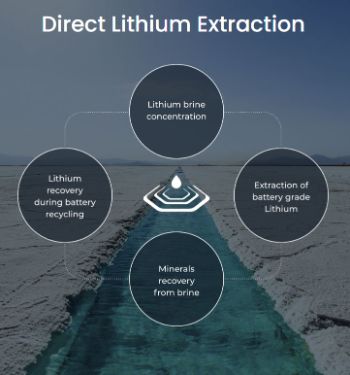
Reaching this milestone enables Weardale to progress its plans for scaling up trials of lithium extraction using the DLE technologies of Watercycle Technologies, supporting and enabling the investment decision for the construction and operation of a pilot-demonstration plant for test-scale production of lithium.
Stewart Dickson, CEO of Weardale Lithium, commented:
“The supply of domestic lithium is of strategic importance to the UK’s net zero ambitions and production of high-value batteries for electric vehicles. Utilising Watercycle’s technology, we have taken a significant step forward in establishing that the naturally occurring geothermal brines are amenable for lithium production and validated a number of direct lithium extraction processes. We look forward to working with the Watercycle team in scaling up and accelerating the testing of increased volumes of brine towards first production.”
Weardale estimates £1 billion of gross economic value could be generated for the North East region
The modular pilot-demonstration facility will be located on the brownfield, former cement works at Eastgate. Commercial production of approximately 10,000 tonnes of lithium carbonate per year is being targeted which has the potential to directly generate around 125 new full-time, highly skilled jobs. At commercial scale, Weardale estimates that £1 billion of gross economic value could be generated for the North East region.
Dr. Seb Leaper, CEO of Watercycle Technologies said:
“These positive results on lithium carbonate extraction are fantastic news. By utilising our propriety membrane technology, we are the first company to produce lithium carbonate from brines in the North East.
“Importantly our ground-breaking DLEC™ technology produces zero waste, is water-neutral and requires 95% less land than conventional lithium extraction processes. Our technology can put the UK at the forefront of the sustainable mineral recovery industry and become a major contributor to future economic growth.”
Watercycle co-founder and CTO Dr Ahmed Abdelkarim added:
“We are not only successfully partnering with lithium brine developers, but we are also making fantastic headway in the extraction of multiple critical minerals from spent batteries...we recently produced commercial grade lithium carbonate and graphite from black mass. These are exciting times, and we look forward to working with our partners and delivering high tech mineral extraction solutions.”
 Enpure Ltd and Clean TeQ Water Ltd have announced a collaboration agreement to bring Clean TeQ Water's Moving Bed Ion Exchange-based nutrient removal technologies to water utilities across the UK.
 Near-real-time microbial monitoring of wastewater discharge and bathing waters is now possible thanks to the BactoSense ID solution created by Swiss-based bNovate Technologies.
 ABB has launched AquaMaster+™, a digital platform for smart water network management, designed to help water utilities monitor, analyze and manage their water networks, preventing pipeline water losses and optimizing operations.
 Craig Nienaber, Business Development Manager for Safe Access Solutions (SAS) at HUBER Technology, explores why the company is seeing a growing level of interest in its safe access solutions for critical infrastructure providers, including their application in wastewater treatment assets.

 Southern Water has released film and images showing what it’s like to walk inside Hampshire’s expanded Yew Hill underground reservoir for the very last time, before it gets filled with water.
 Hear how Scottish Water has completed its £235 million Ayrshire Glasgow Resilience Project - customers across Greater Glasgow, Ayrshire and East Renfrewshire will now benefit from a more secure and resilient water supply.
 Hear how United Utilities is accelerating its investment to reduce spills from storm overflows across the Northwest.