

A new report by the Adaptation Sub-Committee (ASC) of the Committee on Climate Change (CCC) says that while steps are being taken to prepare for climate change, a lack of evidence is making it difficult to judge whether Scotland’s vulnerability to climate impacts is increasing, remaining constant, or decreasing.
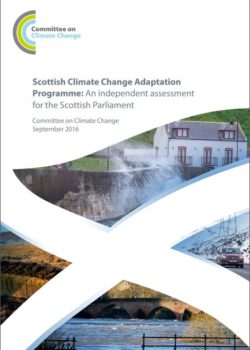 The ASC’s new statutory report published today - ‘Scottish Climate Change Adaptation Programme – an independent assessment’, is its first to the Scottish Parliament. It provides an interim evaluation of the progress being made to prepare for climate change, two years after the Scottish Government published its inaugural Scottish Climate Change Adaptation Programme (SCCAP) in 2014.
The ASC’s main recommendation is that Scotland should state more clearly what its policies for adapting to climate change are and monitor their implementation. Climate change is already affecting Scotland - increases in average temperatures, sea level and annual rainfall have all been observed.
In those areas where the Adaptation Sub-Committee was able to assess progress, it finds that a range of adaptation policies and plans are now in place and that actions are on track. Specifically, the report shows that:
Natural environment: Ambitious plans are in place to protect Scotland’s natural environment from the impacts of climate change but there is more to do to make sure these ambitions are realised. A number of important species remain in decline due to existing pressures on the natural environment and climate change will exacerbate these. One third of deep peat soils in Scotland are showing signs of erosion and an estimated 16% are completely bare of any peat-forming vegetation.
Buildings and infrastructure networks: Significant action has been taken in recent years to improve flood protection for communities and steps have been taken to improve the resilience of Scotland’s infrastructure in severe weather. However, existing datasets are insufficient to judge whether enough progress is being made to counter the impacts of climate change.
Society: Steps are being taken to manage the risks from extreme weather to people and the health and social care system. However, the future effects of heat on health and wellbeing in Scotland have not been studied and there has been little attempt to understand what support business might need to take advantages of the opportunities that may arise as a result of climate change.
Scottish Government should review whether further action needed to deliver and sustain reductions in average water consumption per person in Scotland
On water demand in the built environment, ASC is calling on the Scottish Government to review before the next SCCAP whether further action is required to deliver and sustain reductions in average water consumption per person in Scotland. As part of the review, the Committee also wants Scottish Water to publish the outputs of their water efficiency trials, including an assessment of the impact of metering.
The report also says the Scottish Environment Protection Agency should begin, by the end of 2017, to publish annual data on water abstraction by industry (separately from agriculture and energy generation) so vulnerabilities can be assessed and managed over time.
Urgent need to review whether current actions are sufficient to manage long-term risks from flooding and extreme weather
Widespread flooding in the winter of 2015/16 highlighted the vulnerability of Scotland’s communities and essential infrastructure to extreme weather. However, according to ASC, there has been no long-term assessment of flood risk management investment needs. Nearly 90% of at risk properties are not protected by flood defences.
The Scottish Government has not assessed whether current plans are consistent with being able to manage long-term flood risk in the context of climate change. Even if current plans are fully implemented, 58,000 properties are projected to have at least 1-in-200 annual chance of being flooded in the 2030s, the report says.
Commenting on Scotland's flood defence provision, the report says there are limited data at a national scale to determine how much progress is being made, commenting:
"There is therefore an urgent need to review whether current actions are sufficient to manage long-term risks from flooding and extreme weather, the impacts of which can otherwise be expected to increase. Development in the floodplain, along with ongoing increases in impermeable surfacing, is likely to be adding to long-term costs and risks due to weaknesses in how planning policy is being implemented."
The Adaptation Sub Committee is recommending outcome-based indicators are developed in the following areas as a priority:
- Levels of exposure to different sources of flood risk around the country, including projections of future risks taking climate change and current and planned flood risk management measures in to account.
- Impact of new development on long-term flood risks and risk management costs, and the use of sustainable drainage systems to help manage surface water flood risks.
ASC says the Scottish Environment Protection Agency should also ensure the next Flood Risk Management Strategies monitor and report on:
- The impact of local flood risk management plans in reducing surface water flood risk, including in relation to managing urban creep.
- The number and capacity of SuDS installed in new developments and of other drainage assets retrofitted with SuDS.
Clean water and natural carbon storage in plants and soils of "significant importance"
The rport points out that clean water and natural carbon storage in plants and soils are also of significant importance. Scotland’s water resources comprise 90% of the total volume of surface freshwater in the UK, with some 35 billion cubic metres of water stored in the 27,000 lochs in Scotland and 42 billion cubic metres in Scotland’s soils.18 Scotland’s peatlands cover about 20% of the total land area (1.7 million hectares) and contain an estimated 1.6 billion tonnes of carbon, ten times more than is stored in all UK trees. According to the ASC, the ‘non-market’ values of clean water and natural carbon stores are increasingly being recognised by policy-makers.
Unclear whether risks are being adequately managed
Introducing the report, Lord Krebs, Chairman of the Adaptation Sub-Committee of the Committee on Climate Change, said:
“Climate change is already affecting Scotland. Average temperatures and sea-levels are rising, and rainfall totals are increasing. Further changes are inevitable in the coming decades. A lot of action is underway to prepare for the impacts of climate change but it’s not clear what’s being achieved and whether risks are being adequately managed. The Scottish Government now needs to develop clearer action plans, and better ways to monitor and review progress, to ensure Scotland is ready for the climate-related challenges ahead.”
Click here to download Scottish Climate Change Adaptation Programme – an independent assessment
 Albion Water, the first NAV (New Appointment & Variation) to have been established in1999 and now under the ownership of SDS Water Group, has appointed Andy Holland as its new Director of Business Development.
 UK water companies are invited to join an upcoming webinar which will explore how the sector can take indirect potable reuse (IPR) from concept to full-scale operational reality.
 James Sumsion, CEO of predictive water intelligence specialists Kohtari, says the water sector needs to take a giant leap forward, so that it can anticipate and act upon water quality issues - rather than merely react.
 Ray Moulds, Sales Director at Flood Control International, takes a look at how automated sliding floodgates are supporting secondary containment at water and sewerage company sites.

 Hear how Scottish Water has completed its £235 million Ayrshire Glasgow Resilience Project - customers across Greater Glasgow, Ayrshire and East Renfrewshire will now benefit from a more secure and resilient water supply.
 Hear how United Utilities is accelerating its investment to reduce spills from storm overflows across the Northwest.
 Find out more about the remarkable career opportunities on offer at WSP - scroll down to watch the inspirational video.