

In an Expert Focus article for Waterbriefing, Paul Taylor, Head of Programme Development in the UK for MWH, now part of Stantec, discusses how the UK water industry can build a talent pipeline over long contracts.
Paul Taylor: The water sector has moved to awarding five or even 10 year contracts with a view to achieving increased value for money, secure supply of labour and materials, and moving delivery risk to companies who are better placed to handle it.
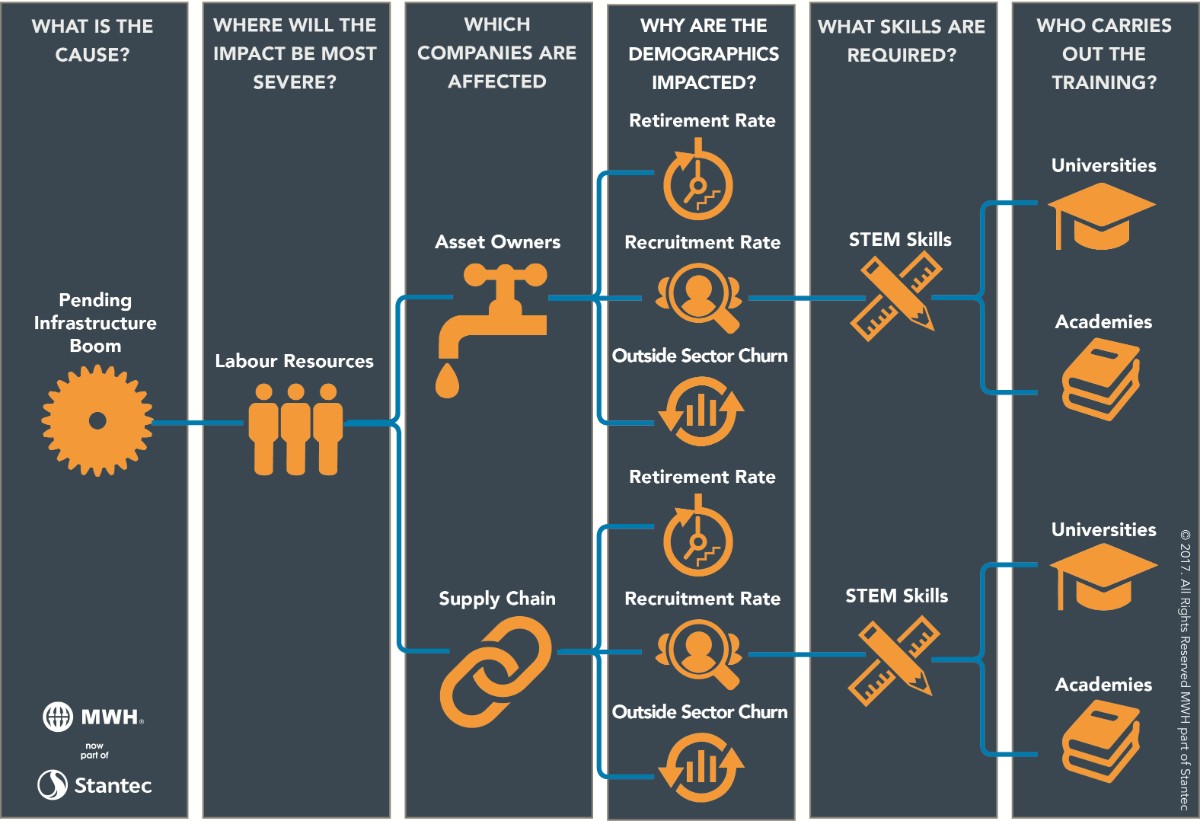
With this in mind and in the context of a fast growing number of infrastructure projects, water asset owners must ensure that mechanisms for developing and sustaining a talent pipeline are in place to provide the engineering, construction and operational skills needed for the mid and long term.
There are five key aspects to consider:
- Determining the future need by understanding the overall programme labour demand.
- A knowledge of the overall supply chains’ resource demographics.
- Identifying the talent needed on future programmes especially with the changing pace of technology.
- Understanding the skills gaps of the current labour force and how they will impact.
- Evaluation of the time and cost to support effective training and development programmes.
All these items need to be addressed to ensure these programmes are sustainable and longer term contracts bring the outcomes and benefits expected.
Future resource demand
The scoping and planning of programmes and long term contracts need to assess the overall resource demand. In the water sector that demand will be known sometime during the PR19 period. As the overall delivery contracts have the possibility to be awarded in lengths of five, 10 or 15 years, the resource demographics must be considered on a longer basis.
In these longer term forecasts we also have to cater for potential changes to engineering processes, construction techniques and overall working practices. This does not mean we need all the information in great detail but instead a rolling wave approach that requires us to have a more depth for earlier years whilst the later years can be considered at a higher level.
Supply chain demographics
There is an opportunity to augment delivery contracts with more expressed terms that ensure the UK water industry has a sustainable level of capability for the future AMPs. These contractual requirements need to apply to manufacturers, contractors and consultants.
To put the approach into context, the average working career will vary between 46 years and 50 years. To allow for a natural succession over a working lifetime we have to assume that in each five-year AMP cycle there is 10% retirement and 10% new intake. This means for a capital investment programme employing 1,000 people, a sustainable level of renewal would be 100 individuals over a single AMP. For two or three AMP cycles it would increase incrementally to 200 and 300 respectively.
From these assumptions, all parties involved in the programme should be developing new staff at around 2% per annum of their involvement. This does not include the turnover of individuals changing sectors as this usually balances out to a neutral position.
New talent for changing technologies
On all future programmes and contracts the advent of BIM and GIS will shift the skills sets within the talent pool. The movement of data from asset owner to designer to contractor and back to asset owner will introduce new working practices. This means companies will have to build closer ties to colleges and universities to keep up with the changing demands technology brings.
There are a number of issues to address within universities. At present we are not enticing enough individuals into engineering degrees and then to the water sector. There is a high demand for all types of engineering graduates but in the past this has been dominated by civil engineers. A worrying statistic highlighted by the ICE is that out of the 3,000 civil engineering graduates, only 30% actually move into a civil based discipline.
We must understand what will attract these graduates who now face significant debts upon entering the world of work. The teaching profession uses mix of bursaries and golden hellos to attract teachers of STEM subjects. There is no doubt we need more science and engineering teachers but at the moment this means the water sector is losing a potential future process engineer.
Understanding the skills gap
One of the catalysts behind the renewed focus on skills is the amount of investment the UK is planning in critical infrastructure. There is going to be an infrastructure boom in sectors such as power generation, rail and roads. If managed well this is will be amassive benefit to the UK but if we are not prepared, it will be a strain on the least adapted infrastructure sector.
If the water sector intends to maintain a reasonable rate of infrastructure re-investment it needs to evaluate the supply and demand of labour and skills both inside the water sector but also in the wider infrastructure market.
In addition, UK industry (including the water sector) has suffered from a systemic problem of under-investing in talent and skills for more than two decades. We are now at a tipping point where any potential increase in capital infrastructure investment will result in the water industry becoming over pressurised by people moving to other sectors. People changing career paths is not unusual but this churn must be managed well or it will impact programme delivery and overall value for money.
Planning an optimum sourcing strategy should be a necessity and this information needs to available before the contracts are awarded. It must be part of the scoring mechanism for awarding contracts as in a constrained market this could be the single biggest risk to costs increasing on a programme.
The sourcing strategy could be a mix of recruitment of new staff, training existing staff, and transfer of people from other programmes.The key to sourcing is to ensure the route is sustainable and not competing with other sectors.
The UK labour market could become more complex for the next few years as how we trade with the EU and rest of the world is worked out. In the longer term over a 5 and 10 year window it will be less of an issue but in the short term the market could become highly competitive and strained.
Training and development
All sectors of UK infrastructure are growing with large scale infrastructure projects such as HS2, Thames Tideway, Crossrail, together with strategies such as the “Northern Powerhouse” and the “Midlands Engine”. Combined, they are putting a strain on resources in the talent pool and revealing that we are not yet equipped to accommodate substantial growth.
In response to this, industries such as rail, nuclear, power generation, transmission and distribution are starting to invest heavily in ensuring they have the right staff capabilities for the next decades.
The focus cannot just be on graduate recruitment. Water businesses could learn from other sectors who are setting up National Skills Academies around the UK. Both asset owners and their delivery supply chain from other sectors are now investing heavily in the next generation of engineers, managers, operatives and for competitive advantage they want their business to be seen at the leading edge of innovation, but as of yet a dedicated water sector academy is not available.
Larger programmes and longer contracts can be used as a catalyst to bring these approaches into the water sector. The asset owning water companies need to lead on this and the setup is needed before AMP7 commences. They should be supported by the delivery supply chain and there must be ways to include SMEs who also stand to benefit from a more skilled workforce.
MWH unites approximately 22,000 employees working in over 400 locations across six continents, collaborating across disciplines and industries to bring water and infrastructure projects to life.
For more information, visit mwhglobal.com or connect via Twitter ,Facebook and LinkedIn.
 Craig Nienaber, Business Development Manager for Safe Access Solutions (SAS) at HUBER Technology, explores why the company is seeing a growing level of interest in its safe access solutions for critical infrastructure providers, including their application in wastewater treatment assets.
 Albion Water, the first NAV (New Appointment & Variation) to have been established in1999 and now under the ownership of SDS Water Group, has appointed Andy Holland as its new Director of Business Development.
 UK water companies are invited to join an upcoming webinar which will explore how the sector can take indirect potable reuse (IPR) from concept to full-scale operational reality.
 James Sumsion, CEO of predictive water intelligence specialists Kohtari, says the water sector needs to take a giant leap forward, so that it can anticipate and act upon water quality issues - rather than merely react.

 Hear how Scottish Water has completed its £235 million Ayrshire Glasgow Resilience Project - customers across Greater Glasgow, Ayrshire and East Renfrewshire will now benefit from a more secure and resilient water supply.
 Hear how United Utilities is accelerating its investment to reduce spills from storm overflows across the Northwest.
 Find out more about the remarkable career opportunities on offer at WSP - scroll down to watch the inspirational video.