

New analysis conducted by the Wildlife and Countryside Link and The Rivers Trustof official Environment Agency data has revealed the worrying scale of chemical cocktail pollution in rivers and other freshwater sites across England.
The research, which looked at the prevalence of 5 chemical cocktails known to have toxic impacts for wildlife, also highlights the lack of official monitoring for known harmful chemical cocktails, as well as the lack of a regulatory framework to address these mixtures.
Findings from Wildlife and Countryside Link and The Rivers Trust reveal that:
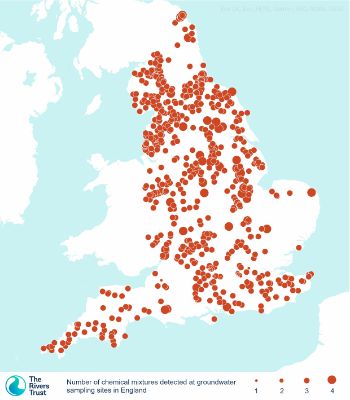
- Chemical cocktails, that have been proven harmful to wildlife in scientific studies, have been found in 814 river and lake sites (out of 1,006 sites with data - 81% ) and 805 groundwater sites (out of 1,086 sites with data - 74%) across England.
- Over half (54%) of these sites contained 3 or more of the 5 harmful chemical cocktails investigated
- Up to 101 chemicals were identified in river samples, with sites along the rivers Mersey, Stour, Colne, Thames, Trent, Yare, Irwell, Medway, Humber and Avon among those containing the highest numbers of chemicals. The actual numbers of chemical pollutants will be even higher

The NGOs, together with other charities, are today launching a ‘Chemical Cocktail Campaign’ and calling on the Government to take a much more ambitious approach to regulating harmful chemicals.
Their call includes asking Government to include in its forthcoming UK Chemicals Strategy:
- regular monitoring for chemical cocktails in rivers
- new legal protections against dangerous chemical cocktails, including requiring assessments of potential hazardous chemical mixture impacts before any new chemical is allowed on the market.
Richard Benwell, CEO of Wildlife and Countryside Link, said:
“A harmful chemical cocktail is being stirred up in UK rivers, putting wildlife and public health at risk. Government regulates and monitors chemicals individually, ignoring the cocktail effect. But our research shows that toxic combinations of pesticides, pharmaceuticals and forever chemicals are polluting rivers up and down the country. The new Chemicals Strategy must make sure harmful substances are regulated not just for individual risks, but for their effects in combination.”
The chemical cocktails found across the 1,619 sites contained six different chemicals in 5 different hazardous mixtures.
These included four toxic forever chemicals PFOS, PFOA, PFBS and PFHxS, the pesticide 2,4-D and the commonly used painkiller ibuprofen. In specific combinations these chemicals are known to have increased harmful impacts on a range of species including amphibians, fish, insects, nitrogen-fixing bacteria and algae.
All of the chemical combinations focused on cocktail impacts with the harmful and extremely prevalent forever chemicals perfluorooctane sulfonate (PFOS) and perfluorooctanoate (PFOA) . These were chosen due to how widespread they are (despite having been banned) and the need for them to be recorded under Water Framework Directive requirements, making them more visible chemical contaminants for assessment.
Identified detrimental effects included reduced growth, cell function, impacts on embryos and lower survival rates. Any potential human health implications, for example through contact via bathing or recreation, remain unknown.
Some of the sites where all five chemical cocktails were found include: The Chelt (in Cheltenham); The Derwent (in Yorkshire); The Trent (in Staffordshire); The Exe (in Devon); The Ouse (in Lewes East Sussex); the Wansbeck (in Northumberland); and the Yare (in Norfolk).
Rob Collins, Director of Policy and Science at the Rivers Trust, said:
“We need to stop pumping poison into our rivers. Hazardous chemicals are flowing into our waters, derived from every aspect of our lives. On the small-scale from the toiletries, food packaging, clothing and other goods we use individually, to large-scale industrial, medical and food production, we are creating an ever-growing chemical cocktail in our rivers. The fact that these known toxic chemical combinations are found so widely across the country is deeply worrying. And that’s just the tip of the iceberg. Unless we act now we’ll see increasingly contaminated water, less wildlife in our rivers and ocean, and this raises implications for human health as well.”
The other charities involved in the campaign include Surfers Against Sewage, Buglife, WildFish, Fidra, Pesticide Action Network UK, The Wildlife Trusts, The National Trust, Whale and Dolphin Conservation and the Pesticide Collaboration.
EAC Chair Philip Dunne MP says "long-standing prevalence of harmful chemicals means no river in England is in good chemical health"

Speaking at a Parliamentary event on chemical cocktail pollution yesterday, the Rt Hon Philip Dunne MP, Chair of the UK Parliament Environmental Audit Committee, said:
“The country’s precious waterways should be as free from pollutants as possible, yet the long-standing prevalence of harmful chemicals has meant that no river in England is in good chemical health. How these chemicals interact with each other could be deadly to creatures living in freshwater habitats.
“During the course of the Committee’s inquiry examining water quality of rivers, we were alarmed at the lack of monitoring taking place for harmful pollutants, including chemicals. We must know what we’re tackling, so monitoring and assessment is absolutely critical. The Committee concluded that annual chemical assessments should take place.
“These findings are a timely reminder that the chemical cocktail in inland waters is affecting every corner of the country. It raises concerns about the potential harm to human health and it is leaving destruction of nature in its wake. The Government should build on its plans to improve water quality by having a clear roadmap on how to address the dangerous chemical cocktail coursing through England’s waterways.”
 Albion Water, the first NAV (New Appointment & Variation) to have been established in1999 and now under the ownership of SDS Water Group, has appointed Andy Holland as its new Director of Business Development.
 UK water companies are invited to join an upcoming webinar which will explore how the sector can take indirect potable reuse (IPR) from concept to full-scale operational reality.
 James Sumsion, CEO of predictive water intelligence specialists Kohtari, says the water sector needs to take a giant leap forward, so that it can anticipate and act upon water quality issues - rather than merely react.
 Ray Moulds, Sales Director at Flood Control International, takes a look at how automated sliding floodgates are supporting secondary containment at water and sewerage company sites.

 Hear how Scottish Water has completed its £235 million Ayrshire Glasgow Resilience Project - customers across Greater Glasgow, Ayrshire and East Renfrewshire will now benefit from a more secure and resilient water supply.
 Hear how United Utilities is accelerating its investment to reduce spills from storm overflows across the Northwest.
 Find out more about the remarkable career opportunities on offer at WSP - scroll down to watch the inspirational video.