
EU Climate Change Service warns global warming exceeded 1.5C for full year between Feb 23- Jan 24
 The EU’s Copernicus Climate Change Service (C3S) is warning that global warming exceeded 1.5C for a full year.
Met Office and University of East Anglia confirm 2023 as warmest year on record globally
 Globally 2023 was the warmest year in a series stretching back to 1850, according to figures just released today by the Met Office and the University of East Anglia.
Copernicus: Official - 2023 is hottest year on record, with global temperatures close to 1.5°C limit
 It’s official - the Copernicus Climate Change Service (C3S) says that unprecedented global temperatures from June onwards led 2023 to become the warmest year on record – overtaking by a large margin 2016, the previous warmest year.
Met Office warns 2024 could be first chance of 1.5 °C year
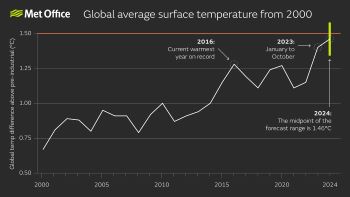 The Met Office is warning that the outlook for global temperature suggests 2024 will be a further record-breaking year, expected to exceed 2023, which is itself almost certain to be the warmest year on record.
UN warns as Greenhouse Gas concentrations hit record high - again
 The abundance of heat-trapping greenhouse gases in the atmosphere once again reached a new record last year and there is no end in sight to the rising trend, according to a new report from the World Meteorological Organization (WMO).
State of Climate Action Report finds progress lags on every measure except EV sales
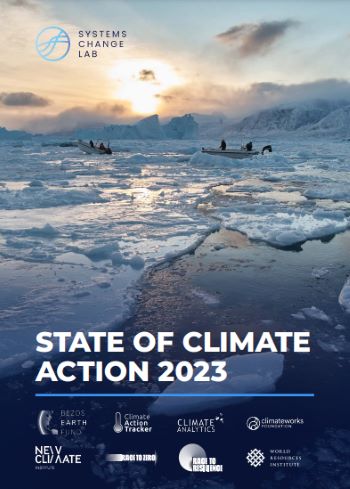 Global efforts to limit warming to 1.5°C are failing across the board, according to the State of Climate Action 2023 report. The report says that with the exception of electric passenger car sales, recent progress made on every indicator is lagging significantly behind the pace and scale that is necessary to address the climate crisis.
Copernicus: Record temperatures in October mean 2023 “virtually certain” to be warmest year on record
 The EU’s Copernicus Climate Change Service is warning that “exceptional temperature anomalies” in October mean 2023 is “virtually certain” to be warmest year on record.
Water UK - new report calls for development of National Bioresources Strategy for England
 Water UK has published a new report on developing a long-term strategy for bioresources in England, working collaboratively on the project with regulators and stakeholders across the industry to develop a common understanding of the challenges and opportunities for bioresources.
Scottish Water in pioneering £3 million green hydro energy generation at East Lothian reservoir
 Scottish Water has broken ground on a pioneering new type of hydro energy generation scheme at Whiteadder Reservoir, East Lothian as part of its work to reduce carbon emissions.
Antarctic sea ice extent reaches new record low
 Antarctic sea ice extent has reached a new record low – the sea ice is more than 1 million square kilometers (386,000 square miles) below the previous record low maximum set in 1986.
News Showcase
-
ABB launches digital platform for optimizing operation of water networks
 ABB has launched AquaMaster+™, a digital platform for smart water network management, designed to help water utilities monitor, analyze and manage their water networks, preventing pipeline water losses and optimizing operations.
 -
Safe access solutions a key requirement for water sector and other Critical Infrastructure Providers
 Craig Nienaber, Business Development Manager for Safe Access Solutions (SAS) at HUBER Technology, explores why the company is seeing a growing level of interest in its safe access solutions for critical infrastructure providers, including their application in wastewater treatment assets.
 -
Albion Water appoints new Director of Business Development
 Albion Water, the first NAV (New Appointment & Variation) to have been established in1999 and now under the ownership of SDS Water Group, has appointed Andy Holland as its new Director of Business Development.
 -
Webinar to explore moving indirect potable water reuse to full implementation
 UK water companies are invited to join an upcoming webinar which will explore how the sector can take indirect potable reuse (IPR) from concept to full-scale operational reality.
Expert Focus


News Sections
Other Latest News
- Anglian Water establishes new £1.5 billion Major Projects Framework with two delivery partnerships
- RSE announces sponsorship of IWA World Water Congress & Exhibition
- NI Water to hold supplier market briefing event for upcoming £12.6 billion Integrated Partnerships Framework procurement
- Smart Water Network Forum issues call for abstracts for 17th SWAN Annual Conference in May 2027
- Thames Water gains access to in £230 million further funding following results of 13th Consent Requests and STID Proposal
- Severn Trent Water seeks supply chain interest in coal mining risk assessment framework
Watch
-
Southern Water showcases last footage inside Yew Hill Reservoir before filling
 Southern Water has released film and images showing what it’s like to walk inside Hampshire’s expanded Yew Hill underground reservoir for the very last time, before it gets filled with water.
 -
Scottish Water completes £235m investment in two-way connection between drinking water networks
 Hear how Scottish Water has completed its £235 million Ayrshire Glasgow Resilience Project - customers across Greater Glasgow, Ayrshire and East Renfrewshire will now benefit from a more secure and resilient water supply.
 -
United Utilities accelerates investment to reduce spills from storm overflows across Northwest
 Hear how United Utilities is accelerating its investment to reduce spills from storm overflows across the Northwest.
Top Stories
Login / Register
New Account Registrations
To register for a new account with Waterbriefing, please contact us via email at waterbriefing@imsbis.org
Existing waterbriefing users - log into the new website using your original username and the new password 'waterbriefing'. You can then change your password once logged in.