

Anglian Water looks set to roll out more pump optimisation in AMP6 following a successful project on its DMA water network using innovative automatic pump pressure technology which has generated annual cost savings of £28,000-plus.
The use of i2O’Water's Automatic Pump Pressure Optimisation solution in its Terrington District Zone (DZ), where the Marham Water Pumping Station Supplies four District Metered Areas (DMAs) has resulted in predicted total annual savings of £28,492 per annum in a payback time of less than eight months.
The project has also delivered significant energy savings and improved customer service in the pump-fed district zone – key issues for both Anglian Water and the other utilities in AMP6.
Preliminary data has suggested that burst frequency will drop by 38%, coupled with a 55% reduction in proactive detection hours.
Anglian Water’s ‘Love Every Drop’ initiative is underpinned by a number of business goals, including achieving 100% customer satisfaction and making the company a frontier performer in the industry.
To support delivery of the goals, the firm put a source-to-tap Optimised Water Networks (OWN) strategy in place aimed at encouraging cross-departmental collaboration to improve operational efficiency.
Proactive control a key priority for Anglian
Anglian’s OWN team wanted to find more intelligent methods for controlling the pump-fed Terrington District Zone, with the aim of reducing bursts, lowering energy consumption and improving customer service. The zone iis very flat with long distances between the pumps and the critical points in each DMA, requiring high levels of energy to pump water around the zone. The zone had an average burst rate of 36 bursts per year, increasing leakage and disrupting customer service. The bursts also tended to be scattered across the DMAs, complicating repairs and ruling out asset replacement as a cost-effective option for reducing burst frequency.
In 2009, Anglian Water installed an optimised control system based on time scheduled discharge pressure settings as a means of controlling the pumps in an energy saving scheme. However, changes in seasonal demand, high agricultural use in the area and numerous critical points meant the firm was unable to maximise the benefit of the settings. The challenges prompted Anglian Water to seek more innovative and intelligent methods to control this part of the distribution network.
Andrew Smith, Regional Network Optimisation Manager for Anglian Water commented:
“There’s a 28-mile distance between the pumps and one of our critical points, and we were seeing high hydraulic losses; so finding a better way of proactively controlling the zone was a key priority for us.”
i2O technology at core of Anglian Water’s optimisation strategy
 Having previously achieved success using i2O’s Automatic PRV Pressure Optimisation solution on a number of DMAs, Anglian Water decided to trial i2O’s Automatic Pump Pressure Optimisation solution on the four DMAs in the Terrington DZ.
Andrew Smith said that i2O’s Advanced Pressure Management solutions are at the core of Anglian Water’s optimisation strategy so the firm had naturally looked to them to also help address the issues with the Marham Pumping Station.
The utility opted for a proof of concept trial on the pumps, with the objective of lowering power consumption, reducing leakage, minimising bursts and improving customer service.
In December 2012, after a period of logging, the i2O Automatic Pump Pressure Optimisation solution began optimising pressures in the four DMAs in Terrington DZ.
Sean McCarthy, Strategy Manager with the OWN team said:
“The water supply team, the network optimisation team and the energy team worked together alongside i2O’s consultants, which not only made the business case much stronger, but also ensured greater insight and understanding of the overall impact.”
“This was the key in driving greater efficiencies from the project rather than small departmental improvements. i2O were instrumental in helping us achieve this, and were able to highlight and directly address problems and opportunities.”
All water companies face same challenges around cost and customer service
Andrew Smith added the project had really reinforced Anglian Water’s collaborative approach and improved how it controlled and monitored pumps. He said:
“All water companies are facing the same challenges around cost and customer service. i2O is enabling us to address these opportunities effectively and efficiently, and gain greater insight in the process.”
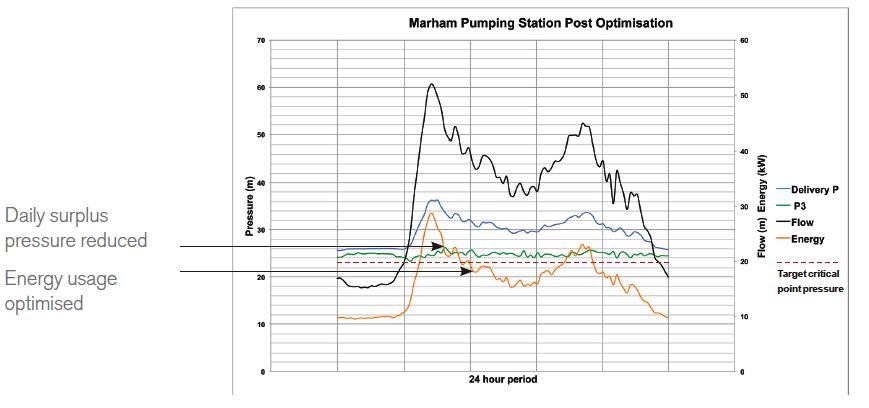
Use of the i2O technology has delivered a number of key benefits. Minimising average and maximum pressures reduces leakage and burst frequency, and associated costs for operational tasks, such as repairs and leakage control. In pump-fed network zones, the automatic optimisation of pressure also reduces energy consumption. Average Zonal Pressure was reduced from 31m to 26m and total daily inflow was reduced by 263m³/day, saving 4.3% of the volume of water required to serve the area.
The reduction in daily inflow and water loss from bursts and leaks reduced energy consumption by 72 kW per day, equating to 8.4% savings. Anglian Water has also been able to remove 31 properties from the DG2 (low pressure) register.
Following on from the project, Anglian Water has gone on to evaluate all of the pumps in its network to identify which areas would benefit from i2O’s technology.
Dave Ward Head of Water Networks for Anglian Water commented:
”Network, but more importantly, system optimisation is a key strategy for Anglian Water. We know there is a lot of opportunity to optimise our pumping and distribution systems. This project demonstrates the importance of understanding your network and using the right technology to secure a more resilient supply and deliver better customer service.”
Worldwide, sixty six water companies in 22 countries are now operating more than 1,700 Advanced Pressure Management systems from i2O Water - with customers typically achieving ROI within 6-18 months.
Click here to read the story in full
 Enpure Ltd and Clean TeQ Water Ltd have announced a collaboration agreement to bring Clean TeQ Water's Moving Bed Ion Exchange-based nutrient removal technologies to water utilities across the UK.
 Near-real-time microbial monitoring of wastewater discharge and bathing waters is now possible thanks to the BactoSense ID solution created by Swiss-based bNovate Technologies.
 ABB has launched AquaMaster+™, a digital platform for smart water network management, designed to help water utilities monitor, analyze and manage their water networks, preventing pipeline water losses and optimizing operations.
 Craig Nienaber, Business Development Manager for Safe Access Solutions (SAS) at HUBER Technology, explores why the company is seeing a growing level of interest in its safe access solutions for critical infrastructure providers, including their application in wastewater treatment assets.

 Southern Water has released film and images showing what it’s like to walk inside Hampshire’s expanded Yew Hill underground reservoir for the very last time, before it gets filled with water.
 Hear how Scottish Water has completed its £235 million Ayrshire Glasgow Resilience Project - customers across Greater Glasgow, Ayrshire and East Renfrewshire will now benefit from a more secure and resilient water supply.
 Hear how United Utilities is accelerating its investment to reduce spills from storm overflows across the Northwest.